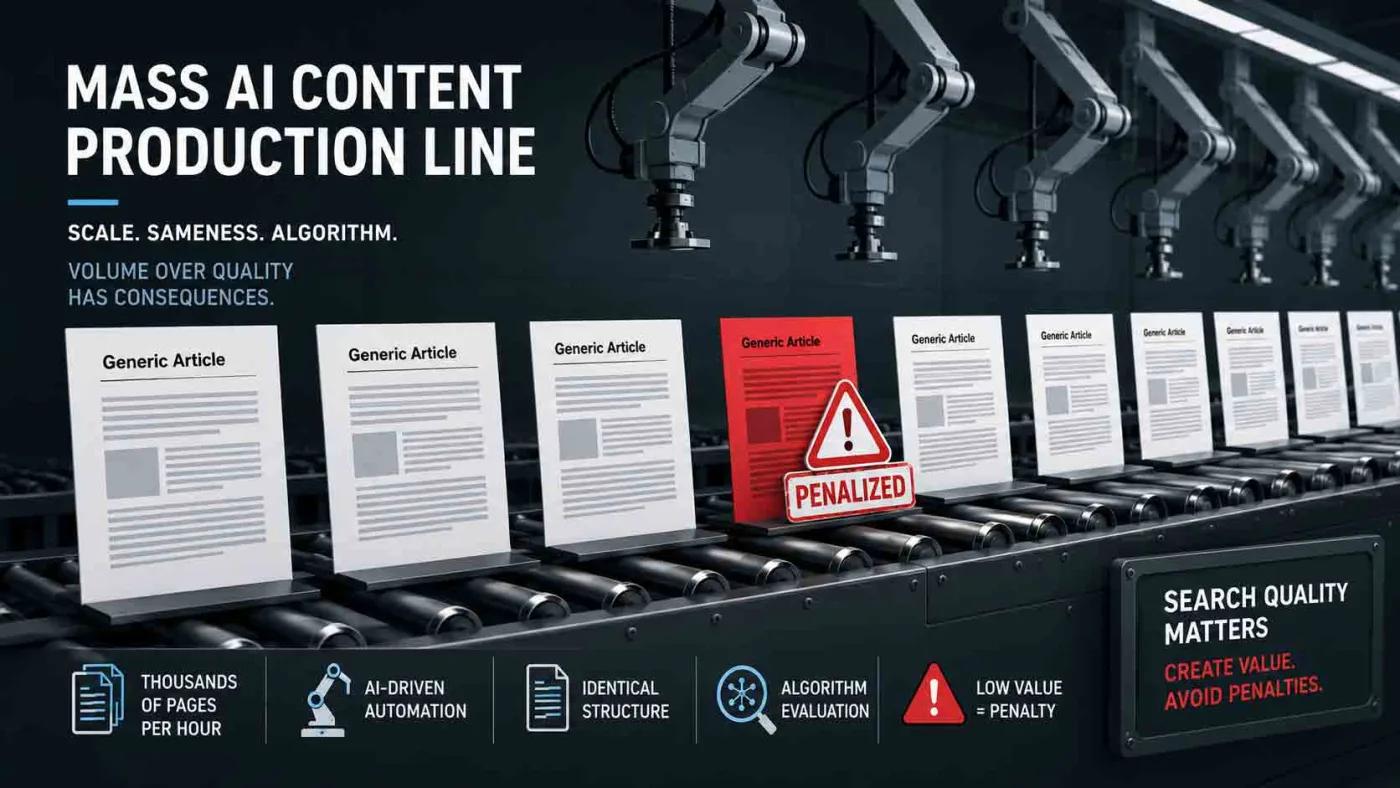
In March 2026, Google rolled out one of its most aggressive crackdowns yet on what it calls "scaled content abuse." Sites that had been publishing anywhere from 50 to 500 AI-generated articles a day, with no editorial oversight, saw organic traffic drop by 50–80%, according to an analysis by Digital Applied. The message is unambiguous: AI tools aren't the problem — misusing them is, and it can permanently tank a site's visibility.
Google has confirmed this officially in its documentation for site owners: the scaled content abuse policy applies regardless of whether a page was written by a human, an AI, or some combination of both — the focus isn't on the tool but on intent and value delivered to the user. Here are the five most common mistakes companies and content creators make when bringing AI into their SEO strategy — and what official sources say about avoiding them.
Mistake 1: Publishing AI output without editing it
The most widespread mistake is treating AI output as a finished product. Google Search Central explicitly states that generative AI can be useful for researching a topic and adding structure to original content, but that using AI tools to mass-produce pages without adding value for users may violate the scaled content abuse policy.
The practical dividing line, according to multiple analyses published throughout 2026, is human oversight: content that a knowledgeable person has reviewed, fact-checked, and shaped for a real audience stays within the rules, no matter what tool produced the first draft. Content that's generated and published without any review, at volume, purely to capture search traffic, falls squarely into abuse territory.
Mistake 2: Ignoring E-E-A-T
AI models have no lived experience by definition — they can't test a product, describe their own professional background, or offer an authentic opinion built on years of work in a field. When that kind of text gets published without adding real authorship, expertise, and practical examples, it fails to meet Google's Search Quality Rater Guidelines, which explicitly call for evidence of experience, expertise, authoritativeness, and trust.
This issue becomes even more sensitive on so-called YMYL topics (Your Money or Your Life) — health, finance, legal matters — where content that misrepresents the author's level of expertise carries a significantly higher penalty risk. The fix isn't abandoning AI, but adding real credentials: named authors with bios, concrete examples from practice, and, where possible, quotes from named experts — Princeton research shows such quotes boost perceived credibility and citation likelihood by nearly 41%.
Mistake 3: Keyword-stuffing through AI
When an AI tool is explicitly told to "fit in keyword X as many times as possible," the result is text that reads unnaturally and that Google flags as manipulation. Google's official spam policy documentation cites, as an example of abuse, creating pages where the content makes little sense to a reader but is packed with search keywords — a practice that's equally punishable whether a human or a machine wrote it.
Instead of forcing keywords in directly, a more effective and safer approach in 2026 is writing that naturally answers the user's question within the first two or three sentences, letting keyword variations appear organically through context and subheadings rather than artificial repetition.
Mistake 4: Skipping fact-checking
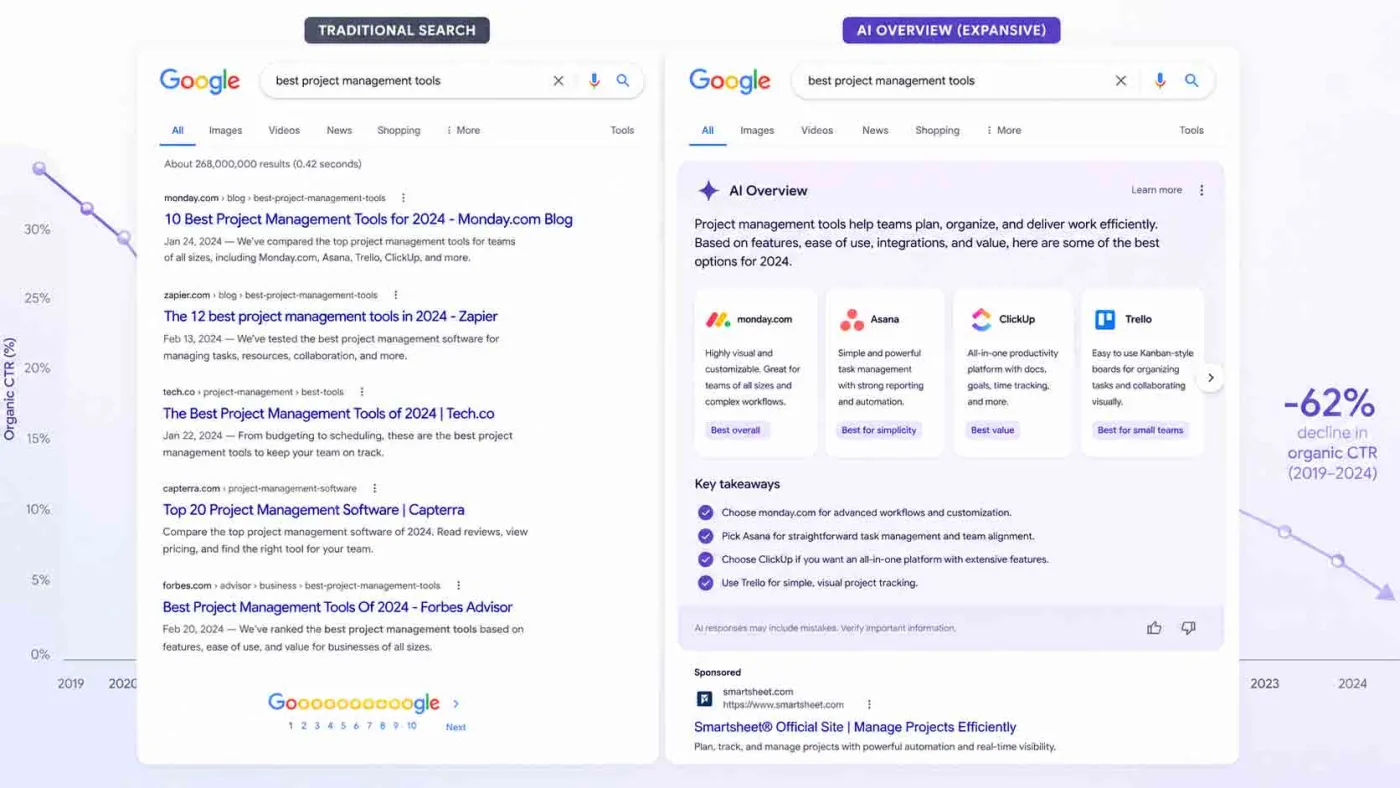
AI models occasionally "hallucinate" — generating statistics, sources, or claims that sound convincing but aren't true. For SEO content this is especially dangerous, because inaccurate information damages credibility not just with readers but with the AI systems now aggregating and citing content from across the web. On May 15, 2026, Google formally extended all its anti-spam policies — including bans on inauthentic mentions and hidden text — to explicitly cover content appearing inside AI Overviews and AI Mode responses, meaning inaccurate or unverifiable content now carries risk on both the classic results list and the AI search layer.
The practical safeguard: every figure, statistic, or claim an AI generates should be independently verified against a reliable, primary source before publishing — the same standard professional journalism has applied for decades.
Mistake 5: Mass production without a strategy
Digital Applied's analysis identifies two of the most common patterns behind penalized scaled production: sites publishing hundreds of nearly identical AI articles a day with no editorial oversight, and the "template-with-variable-substitution" approach — for example, pages like "Best [service] in [city]" repeated across hundreds of cities, where only the city name changes with no original local insight or data. When that kind of content offers no real value to a reader in that specific city, it fits the definition of scaled content abuse.
It's worth stressing that volume by itself isn't the problem — legitimate programmatic SEO, e-commerce catalogs, and local landing pages can exist at scale as long as they provide real utility, accurate data, and content that's genuinely distinct page to page. The violation happens when volume is combined with intent to manipulate rankings and little value for the user.
How to properly combine AI and human input
The common thread running through all five mistakes is the same: AI should be treated as an assistant that speeds up research and the first draft, not a replacement for editorial responsibility. Google confirms this officially — using generative AI isn't against the rules by itself, as long as the final content meets the same standard applied to any other text on the web: originality, accuracy, clear authorship, and real value for the person who came looking for an answer.
Companies that strike this balance — AI for speed, humans for verification, context, and authenticity — not only avoid penalties, but build content with a genuine shot at being cited in AI answers, which is where most of today's battle for visibility is actually happening.
Sources
- Google Search Central, Spam Policies for Google Web Search and Google Search's Guidance on Generative AI Content on Your Website
- Google Search Central, Search Quality Rater Guidelines (sections 4.6.5 and 4.6.6)
- Digital Applied, analysis of the March 2026 core update's impact and scaled content abuse patterns
- ppc.land, report on Google's expansion of spam policies to AI Overviews and AI Mode (May 15, 2026)
- Aggarwal et al., Princeton/KDD 2024, research on the impact of named citations on content credibility and citation likelihood