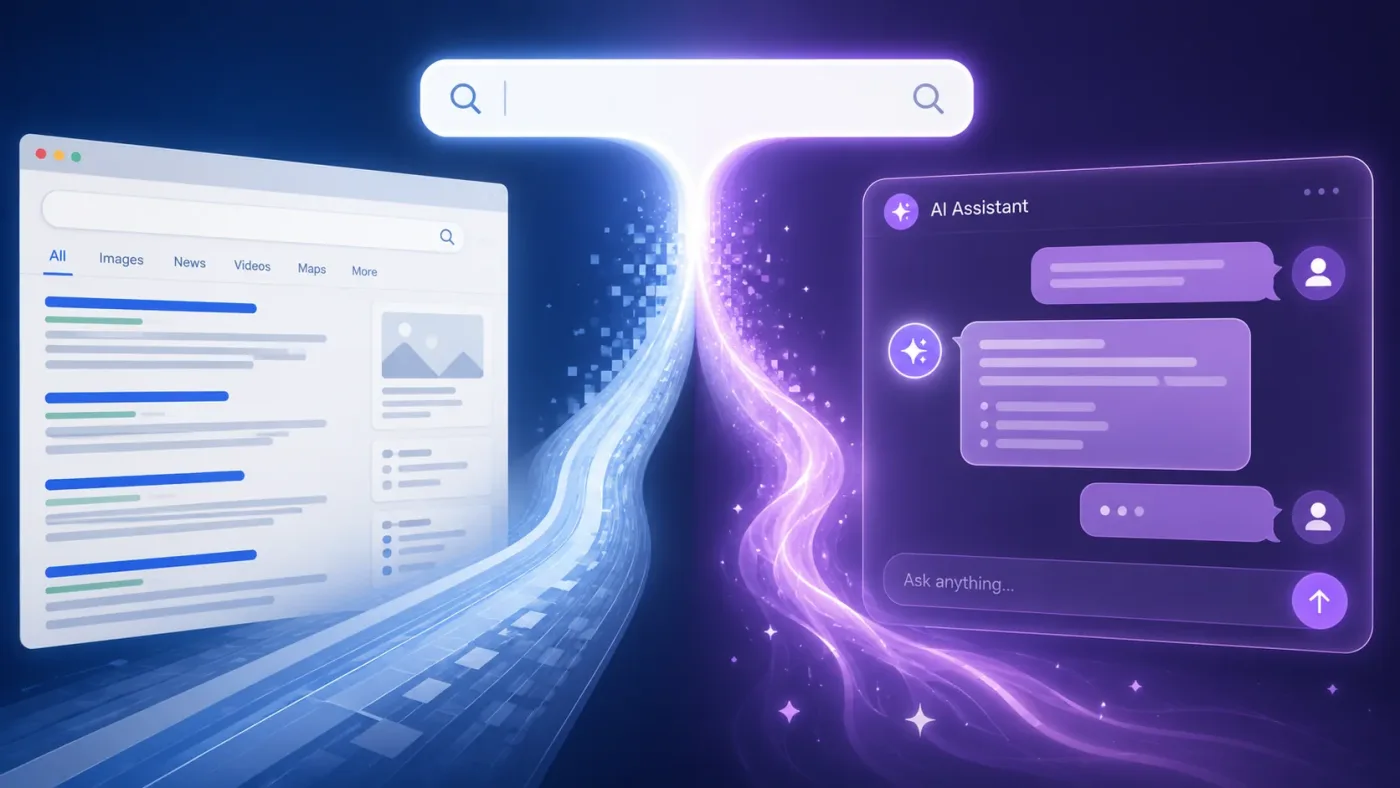
The last three core update cycles have confirmed something that sounded like marketing-blog conspiracy theory just two years ago: Google no longer rewards a good ranking with a click. Increasingly, it gives the answer itself — and keeps the user on its own page. For an industry that spent two decades measuring success by organic visits, this is the biggest shift in the rules of the game since the mobile index rollout.
The numbers behind the theory
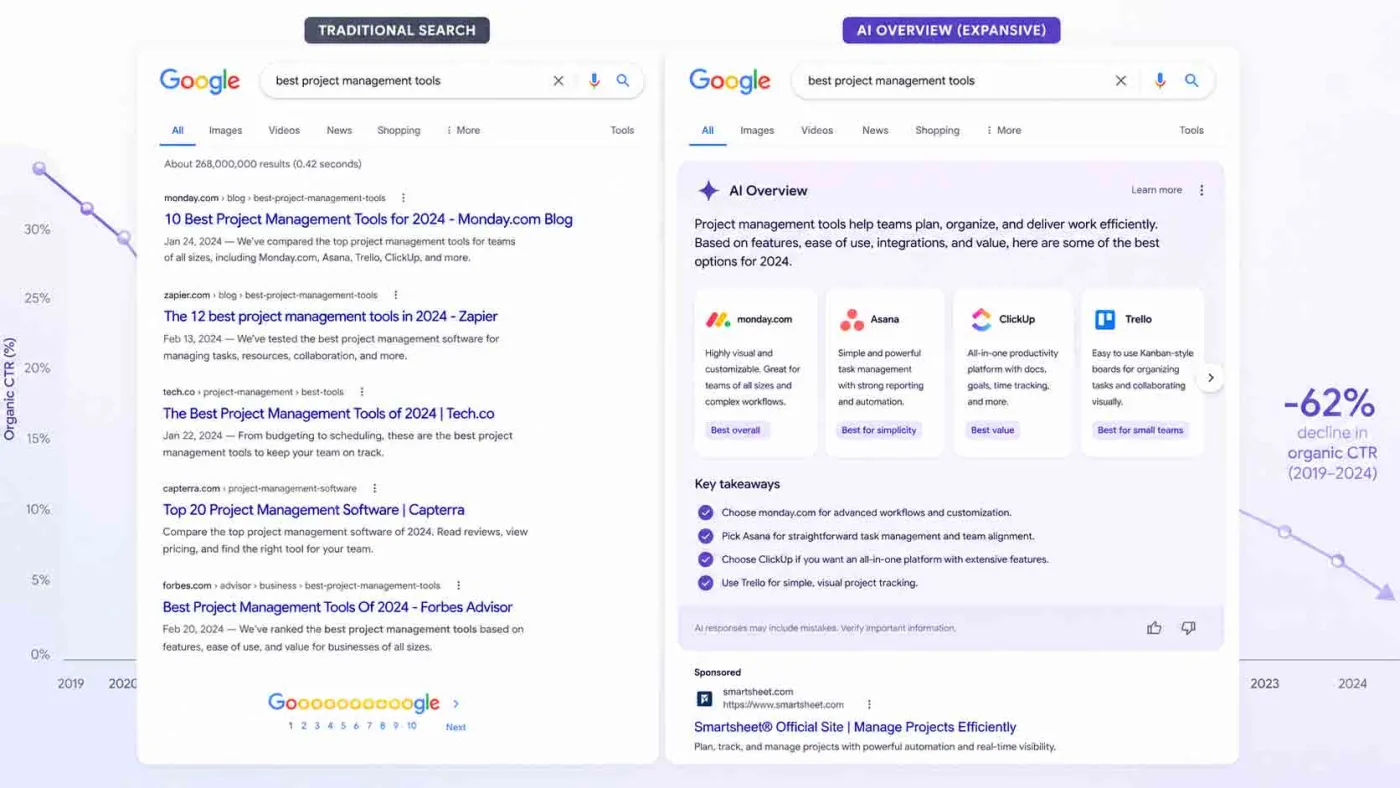
The most extensive study available, conducted by Seer Interactive tracking 53 brands, 5.47 million queries, and 2.43 billion impressions from January 2025 to February 2026, shows that average CTR (click-through rate) on queries where an AI Overview appears fell from 1.76% to just 0.61% between June 2024 and September 2025 — a 65% drop. By February 2026, that number recovered to 2.4%, an 85% jump in just two months, but still well below pre-AI-Overview levels.
An independent Ahrefs analysis of 300,000 keywords reached a similar conclusion: the top-ranking page's CTR fell by 58% when an AI Overview appeared. Pew Research Center, in a panel study of 68,000 queries, found that only 8% of users click an organic result when an AI overview is present, versus 15% when it isn't. A randomized controlled study run between January and February 2026, pre-registered with the AEA RCT Registry, confirmed the causal link: removing AI Overviews increased outbound clicks by 38%, while user satisfaction stayed unchanged — undercutting Google's claim that AI Overviews primarily improve user experience.
New metrics worth tracking
Taken together, these studies show organic search splitting into two separate realities. Queries without an AI Overview are becoming more valuable — their CTR rose from 2.8% to 3.8% over the same period, since Google hands "quick answers" to the AI summary there, while users who still click through are looking for deeper analysis. At the same time, brands cited inside an AI Overview see 35% more organic and as much as 91% more paid traffic than brands the summary doesn't mention, according to Seer Interactive's data.
That means the old focus on ranking position alone no longer fully fits the new reality. Instead of tracking rank in isolation, the relevant metrics for 2026 become:
- AI Overview appearance rate for target queries (varies wildly by industry — as high as 88% of queries in healthcare, but only around 4% in e-commerce, per BrightEdge's analysis)
- Citation rate inside AI answers, regardless of classic organic rank — Ahrefs' analysis of 863,000 queries shows only 17% of AI citations come from pages that also rank in the organic top 10, down from 76% in mid-2024
- CTR measured separately for queries with and without an AI Overview, since blending the two datasets produces a misleading picture of campaign performance
What still works — the old principles that remain essential
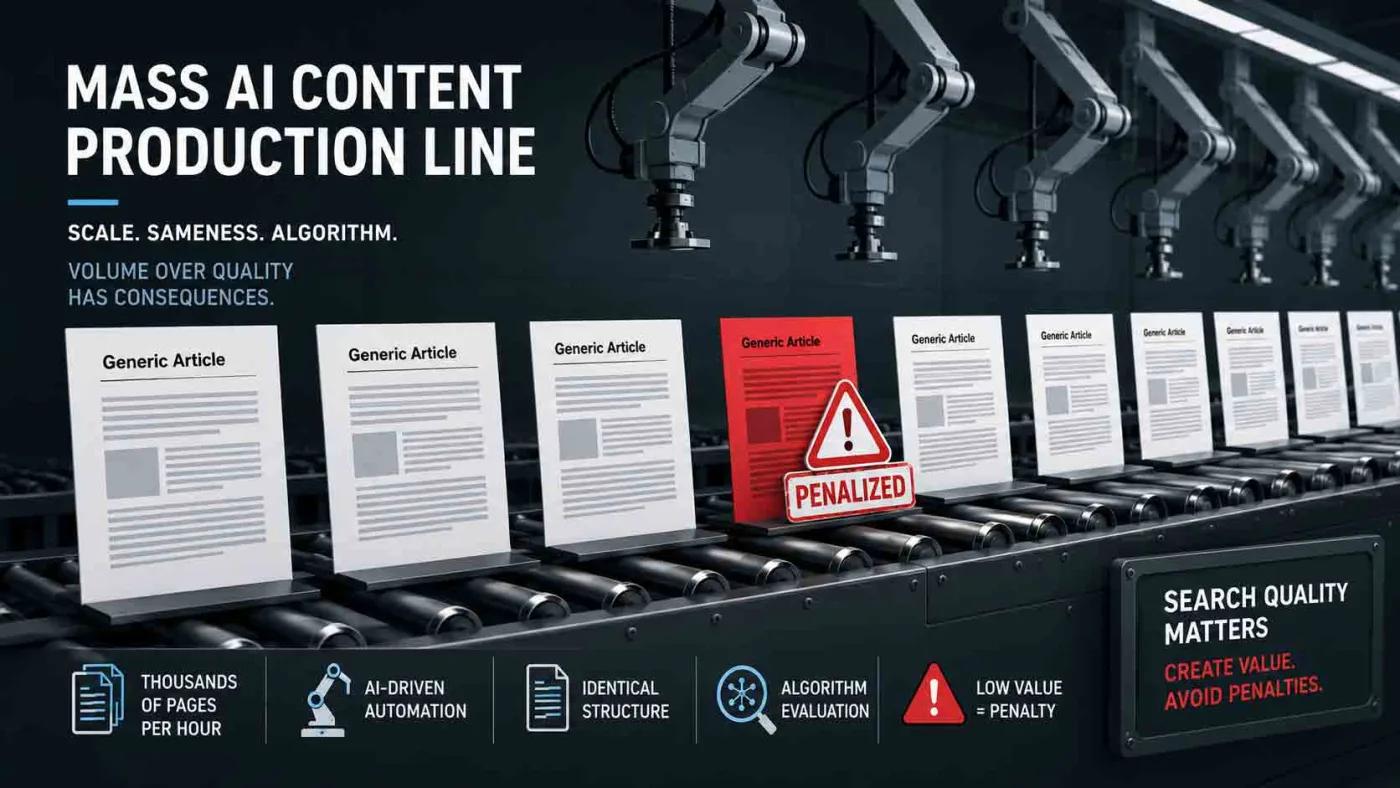
Despite all the change, SEO's foundations haven't collapsed. E-E-A-T (experience, expertise, authoritativeness, trustworthiness) has, paradoxically, become more important than ever — because AI systems still have to decide whom to trust when choosing a source to cite. Content quality, page load speed, and a healthy backlink profile remain prerequisites just to get a page indexed and considered as a candidate for an AI answer at all. Google confirmed this officially on May 15, 2026, when it extended all existing spam policies — including bans on scaled content production, doorway pages, and link manipulation — to explicitly cover AI Overviews and AI Mode as well.
What's new — tactics built for the AI era
Several tactics are specifically relevant to "answer engine" optimization (AEO) — tactics that essentially didn't exist in the standard SEO vocabulary two years ago:
Structured data (schema markup). Google officially states that no special schema is required to appear in an AI Overview, but research shows a clear correlation: controlled paired-page experiments found that the page with properly implemented schema was the only one to appear in the AI Overview and also achieved the best organic rank, while the page without schema stayed indexed but was never cited. The types with the biggest impact are Article, FAQPage, HowTo, and Organization schema, with one non-negotiable rule: schema data must exactly match the page's visible content — Google treats mismatches as a spam signal.
Clear answers up front. AI systems favor pages that answer the question directly within the first few sentences, then build out context afterward — the reverse of the classic journalistic pyramid that builds tension before the payoff.
Named sources and expert quotes. Princeton research (Aggarwal et al., KDD 2024) found that quotes from named experts increase the likelihood of being cited in an AI answer by 40.9%, while statistics with a clearly named source add a 30.6% lift.
Tracking AI bots in log files. Checking whether ClaudeBot, OAI-SearchBot, and PerplexityBot are even reaching your priority pages has become as important as monitoring Googlebot — structured data on a page these bots never visit is simply invisible to them.
Practical steps for 2026
- Split your reporting — track CTR and conversions separately for queries with and without an AI Overview, instead of looking at a single blended average that hides the real picture.
- Implement JSON-LD schema for Article, FAQPage, and Organization content, with strict alignment to the page's visible text.
- Restructure key pages so the answer to the main question sits in the first two or three sentences, with detailed elaboration following after.
- Strengthen E-E-A-T signals — name your authors, add their bios and credentials, and bring in quotes from real experts with full name and title.
- Check your log files to confirm the major AI bots are actually reaching the content you want cited.
Conclusion
The core message for 2026 isn't that SEO is dead — it's that it's transforming from a discipline built around position into one built around citation and trust. As industry analysts have vividly put it, planning traffic around old CTR benchmarks is about as reliable as budgeting your electricity bill using pre-2022 prices. Companies that adapt how they measure success, their technical infrastructure, and the way they write content to this new reality will hold a real advantage — while those still tracking only the old search-results position will find it harder and harder to explain why the numbers aren't moving.
Sources
- Seer Interactive, AIO Impact on Google CTR: 2026 Update, via Search Engine Land
- Ahrefs, analysis of 300,000 keywords and 863,000 queries / 4 million AI Overview URLs
- Pew Research Center, panel study of 68,000 queries
- Agarwal & Sen, randomized controlled study (AEA RCT Registry, Jan–Feb 2026), via Search Engine Journal
- BrightEdge, AI Overview coverage analysis by industry (Feb 2025–Feb 2026)
- Google Search Central, Spam Policies for Google Web Search and Guidance on Generative AI Content
- Aggarwal et al., Princeton/KDD 2024, research on the impact of citations on AI-citation likelihood