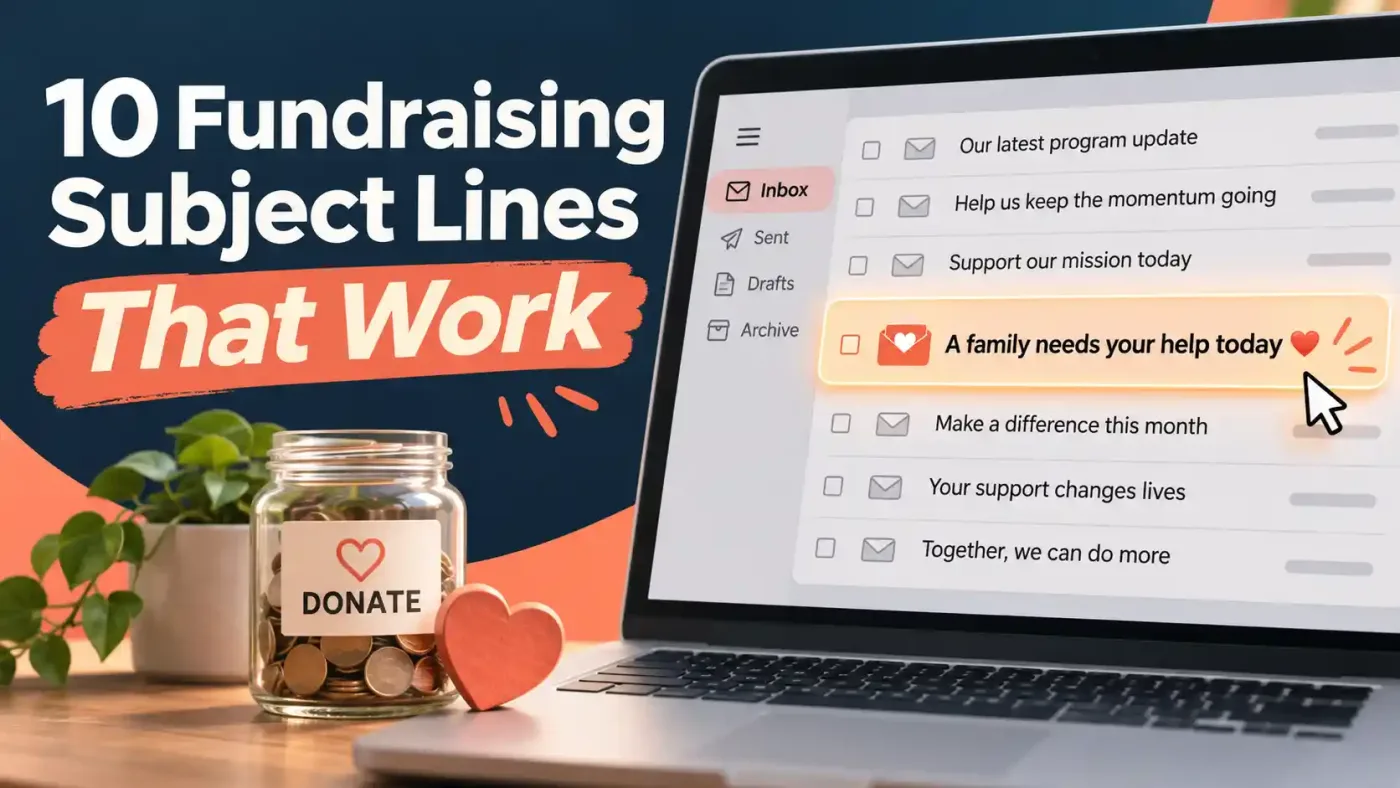
A good fundraising email subject line tells a supporter, in a few honest words, why this email is for them and why it matters now. The ten examples below cover curiosity, gratitude, impact, urgency, personalisation, transparency, community, matching gifts and monthly giving. Treat them as starting points to test. Each one only works if the email behind it keeps the promise the subject line makes, and you should judge it by clicks and gifts, because open rates stopped being reliable in 2021.
The amounts, names, deadlines and places in the examples are illustrations. Replace them with real figures from your own campaign, or don't use the line.
What makes a fundraising email subject line work?
A fundraising subject line works when it is clear about what is inside, relevant to the person reading it, and true. Emotion and urgency help, but only on top of those three. A clever line that the email doesn't pay off can win the open and lose the donor.
Clarity and relevance
The reader should be able to guess what the email is about from the subject line alone. "November update" is clear but gives no reason to open. "What your gift did in October" is just as clear and tells the reader why it concerns them.
Emotion and donor connection
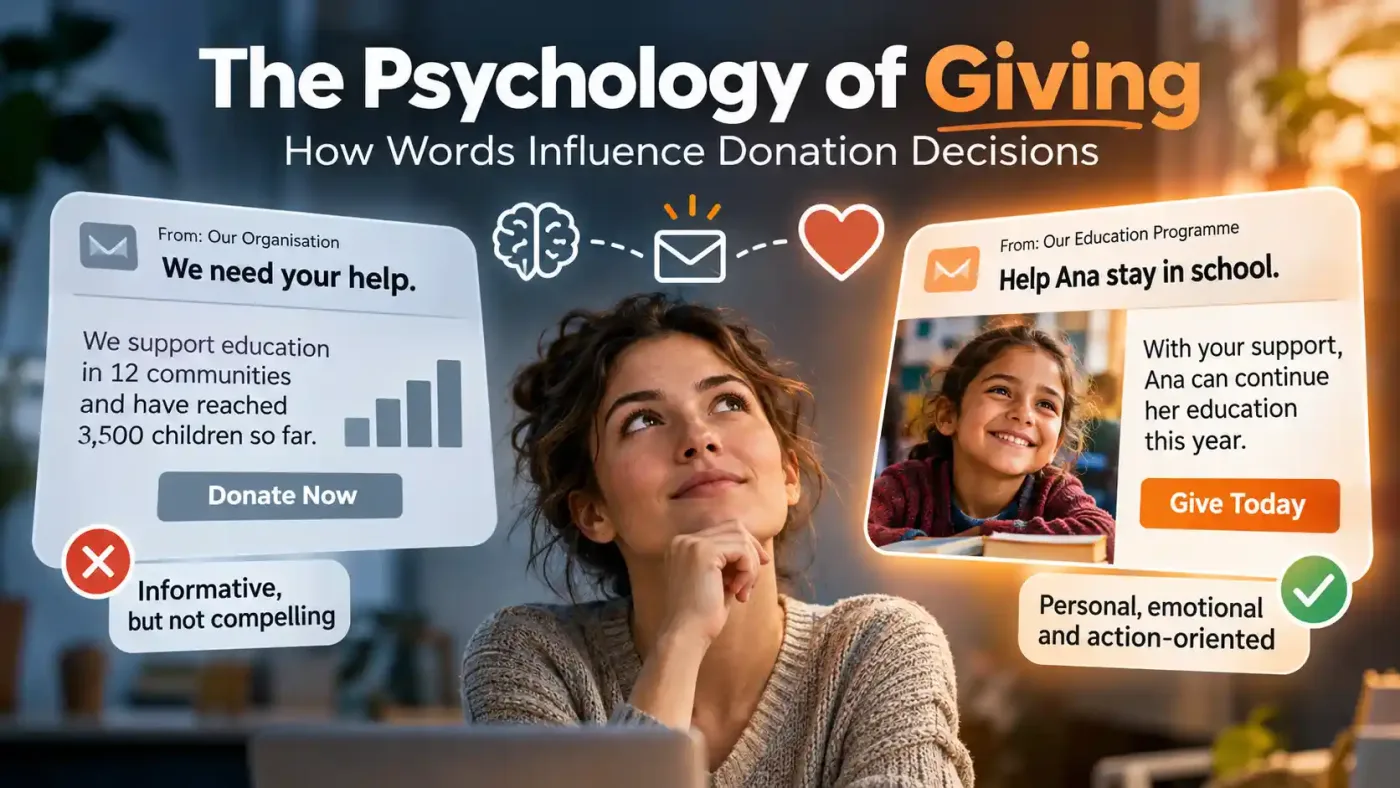
People respond more readily to one person than to a statistic. In a well-known set of experiments, Small, Loewenstein and Slovic (2007) found that people gave more to help one identified child than in response to statistics about millions in need. A subject line can carry that effect, but only if the person and the story are real and shown with dignity.
Personalisation and trust
A first name, or a reference to someone's last gift, can make an email feel addressed to a person rather than broadcast to a list. The evidence on names is mixed (see example 6), and personalisation with bad data does more damage than none.
Urgency that is real
A deadline helps people who already intend to give to actually do it. M+R, a US consultancy that runs the annual Benchmarks study of nonprofit digital fundraising, analysed email content from 12 nonprofits in 2026 and found urgency language associated with a 48% higher click-through rate. The deadline has to exist. Supporters notice when the "final 48 hours" come round every month.
Ten fundraising email subject line examples to try
Each example uses the same format: the line, why it works, when to use it, a preview text to pair it with, and the mistake to avoid.
1. Spark curiosity
Subject line: What happened after your last gift?
Why it works: It raises a question about something the reader did, so the curiosity is personal, not a trick. The email answers it in the first two lines.
Best used for: Impact updates to recent donors, especially before you ask for a second gift.
Preview text: Your gift in March paid for 40 school kits. Here's where they went.
What to avoid: Sending it to people who have never given. For them, "your last gift" is simply untrue.
2. Create an emotional connection
Subject line: One child. One chance to learn.
Why it works: It narrows a large problem to one person and one outcome, which is easier to feel than a percentage.
Best used for: Education and child-focused appeals where you have a real story, told with consent.
Preview text: Lena is nine. The nearest classroom is a 40-minute walk away.
What to avoid: Pity framing and stock photos. The Dóchas Guide to Ethical Communications (2023), written by and for Irish development NGOs, treats respect for the dignity of the people shown as the first test for any story or image. For children, also change names and remove details that could identify them or where they live.
3. Express genuine gratitude
Subject line: You made this possible.
Why it works: A thank-you with no ask is rare in a donor's inbox, and it builds the goodwill your next appeal depends on.
Best used for: The week after a campaign closes, or a welcome after someone's first gift.
Preview text: No ask today. Just what your gift did in its first month.
What to avoid: A thank-you that turns into an appeal halfway down. If the preview text says "no ask", there is no donate button.
4. Show specific donation impact
Subject line: See what your €25 could do.
Why it works: A concrete amount gives the reader a reference point and a picture of the result.
Best used for: One-off appeals where you have costed a real item or service.
Preview text: €25 covers a week of hot lunches for one child at our after-school club.
What to avoid: Amounts nobody has costed. Also check how the gift will be accounted for. In some countries, money given in response to an appeal for a specific purpose may have to be spent on that purpose. If the gift goes into general funds, "helps provide" is safer than "buys".
5. Communicate real urgency
Subject line: Just 48 hours left to help.
Why it works: A visible end point turns "I'll give later" into "I'll give now".
Best used for: Real deadlines: the end of a match, 31 December, a closing emergency window.
Preview text: Our match from a local foundation ends at midnight on Friday.
What to avoid: Invented deadlines, and the vague "to help". Name what ends. "48 hours left to fill 120 winter kits" is stronger because it says what the deadline is for.
6. Make it personal
Subject line: Sarah, here's an update for you.
Why it works: A first name stands out in a column of organisation names. The evidence is promising but not settled. In a large field experiment, Sahni, Wheeler and Chintagunta (2018) found that adding the recipient's name raised the chance of an open by about 20%. A 2023 replication in Marketing Letters found no effect from first names. M+R's 2026 content analysis linked names in subject lines with a 21% higher response rate.
Best used for: Updates to warm supporters, when your name data is clean.
Preview text: Since you joined in 2024, the night shelter has added two evenings a week.
What to avoid: Merge errors ("Hi FNAME"), wrong names, and a name in every subject line until it stops meaning anything.
7. Build trust through transparency
Subject line: Here's where your donation went.
Why it works: It answers a question many donors have and rarely ask, and it shows you expect to be held to account.
Best used for: Annual reports by email, post-campaign reports, re-engaging lapsed donors.
Preview text: The short version of our year, numbers included.
What to avoid: Promising a breakdown and sending a glossy story with a donate button at the top. If the subject line says where the money went, the first screen shows where it went.
8. Emphasise community impact
Subject line: Together, we can reach more families.
Why it works: It casts the donor as part of a group, and information about what others give can move people. In a field experiment with a US public radio station, Shang and Croson (2009) found that telling callers what another donor had given raised contributions.
Best used for: Local appeals, Giving Tuesday, campaigns with a visible donor count.
Preview text: 312 neighbours have given this month. Here's what they've funded so far.
What to avoid: As written, this is the weakest line on the list: "together" and "more families" say very little. Make it specific, for example "312 neighbours have given. Join them?", and only use a count that is real.
9. Highlight matching gift opportunities
Subject line: Your gift could have double the impact.
Why it works: A match gives a reason to act now and signals that another funder backs the work. In a large direct-mail experiment, Karlan and List (2007) found that announcing a match raised both the response rate and revenue per letter, while larger ratios (3:1 instead of 1:1) added nothing extra.
Best used for: Only when a matching funder has actually committed the money.
Preview text: A local business will match every gift up to €5,000 until 31 December.
What to avoid: Hiding the conditions behind "could". If the match is capped, say so, and tell donors when the cap is reached. If the funder would give the money anyway, "double the impact" overstates what the donor's gift does.
10. Encourage monthly giving
Subject line: What could €10 a month change?
Why it works: A small regular amount feels manageable, and the question invites the reader to picture the result. Recurring gifts also matter to the budget: in M+R's 2026 Benchmarks study, many nonprofits received a third or more of their revenue from monthly donors.
Best used for: Converting one-off donors a few weeks after a thank-you, or a dedicated monthly giving push.
Preview text: €10 a month keeps our helpline open for an hour every week.
What to avoid: Asking for a monthly commitment in the same week as someone's first gift, and making it hard to stop. Say in the email how to cancel.
Which subject line fits which campaign?
Match the subject line to what the campaign is actually asking for. The table pairs four common campaigns with the angle that usually fits and the risk to watch.
| Campaign | Approach that fits | Example | Watch out for |
|---|---|---|---|
| Emergency or humanitarian appeal | A concrete need and a real time window | Flood response: 3 days to fund 500 hygiene kits | Figures that change by the hour; update or don't state them |
| Education and child development | One story, told with consent | One child. One chance to learn. | Pity framing, details that identify a child |
| Monthly giving | A small amount and an ongoing result | What could €10 a month change? | Pressuring brand-new donors |
| Year-end | A deadline plus thanks for the year | 3 days left in 2026. Here's what you did this year. | Five "last chance" emails in a row |
Year-end deserves the most care. In M+R's 2026 study, December brought in 37% of the year's online revenue, so your email competes with every other charity's in the same week.
Why do subject lines and preview text need to work together?
Most inboxes show the subject line and preview text together, so readers take them in as one message. The subject line makes the claim, and the preview text backs it up or adds the detail that earns the open. If the preview text repeats the subject line, or shows "View this email in your browser", half your space is wasted.
Three pairs that work together:
| Subject line | Preview text | What the pair does |
|---|---|---|
| What happened after your last gift? | Your gift in March paid for 40 school kits. | A question, then a concrete answer |
| 48 hours left to fill 120 winter kits | Our match ends at midnight on Friday. | A deadline, then the reason for it |
| You made this possible. | No ask today. Just what your gift did. | A promise, then reassurance |
There is a catch. On recent iPhones with Apple Intelligence switched on, Apple Mail can show an AI-written summary of your email in place of the preview text you wrote. You can't control that summary, but you can shape it: state the main point of the email in its first two sentences, in plain words. It helps the human skimmer too. And it means the subject line has to make sense on its own.
Which subject line mistakes cost nonprofits donors?
Most of these mistakes win an open once and cost trust afterwards. Some also hurt delivery. Google's email sender guidelines ask senders to keep the share of email reported as spam below 0.1% and never let it reach 0.3%, and a subject line that feels like a trick invites exactly that report.
Writing generic subject lines
"Our autumn newsletter" and "Please donate today" could come from any charity. Name the specific thing: the project, the place, the result.
Creating false urgency
A deadline that resets every week teaches supporters to ignore your deadlines, including the real ones.
Using misleading emotional appeals
A story that strips someone of dignity may raise money once and harm your reputation, and the people you serve, for much longer. Use the stories people agreed to share, in the way they agreed to share them.
Overusing capitals and emojis
ALL CAPS reads as shouting, and a row of emojis can look like spam. One emoji may work for some audiences. Test it rather than assume.
Ignoring mobile previews
Many phones show only the first few words of a subject line. Put the important word first, then send yourself a test and look at it in your own inbox.
How should a small nonprofit test subject lines?
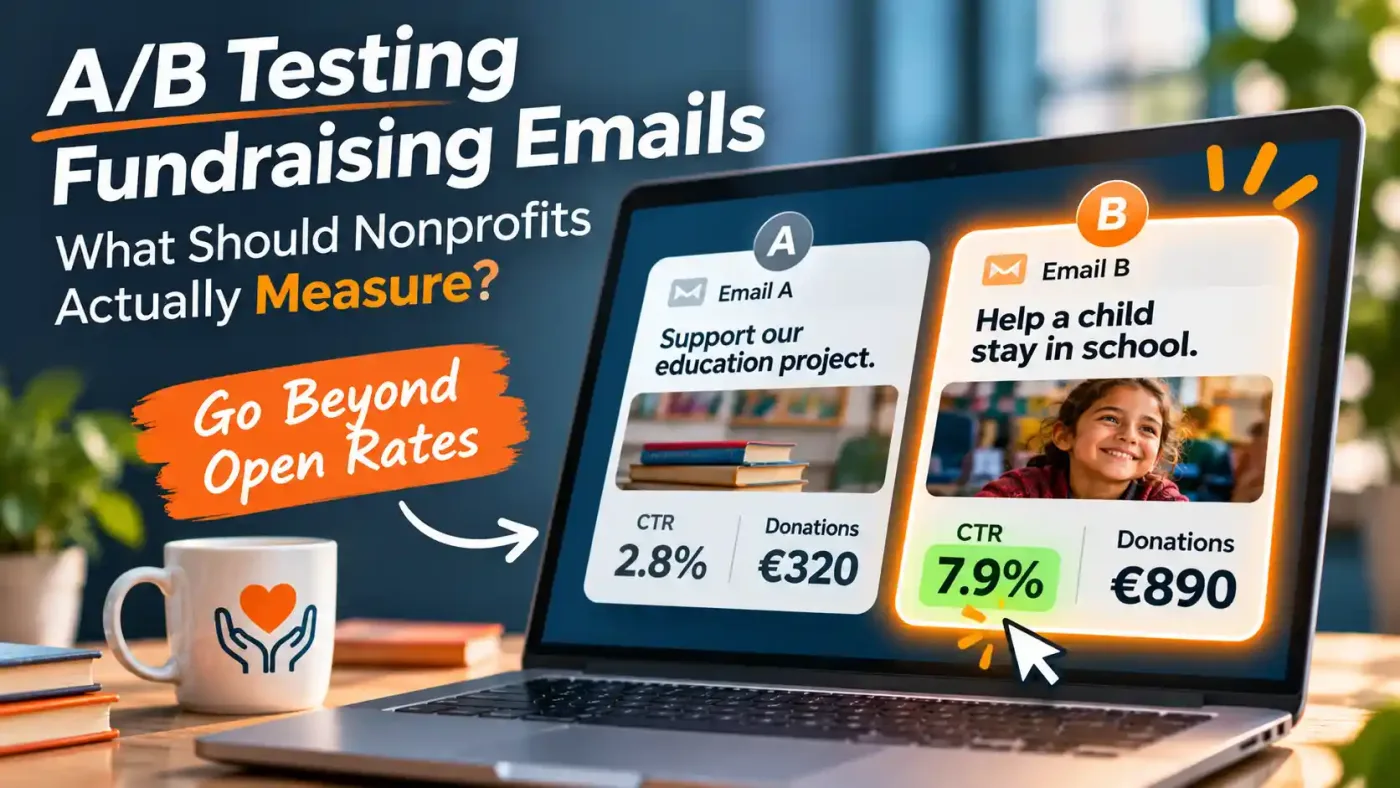
Test one idea at a time, judge it by clicks to the donation page and by gifts, and repeat the comparison across several sends before you trust it. Don't pick winners by open rate. Since 2021, Apple's Mail Privacy Protection has loaded emails in the background for many Apple Mail users, which records opens that never happened. Mailchimp's own help pages warn that it inflates open-related metrics.
Create two versions that differ in one way
Change one thing: the deadline against the outcome, a name against no name, a question against a statement. If you change three things and one version wins, you won't know why.
Run a simple A/B test
Most email platforms let you send version A to half the list and version B to the other half. Decide before you send what will count as a win.
Measure clicks, donations and revenue
Small lists face hard arithmetic. In M+R's 2026 study, fundraising emails averaged a 0.59% click-through rate and a 0.05% response rate, roughly one gift per 2,000 emails. If your list behaves like that average, splitting 3,000 subscribers in half gives each version about nine clicks and less than one gift. One send cannot tell you which subject line raises more money.
That is no reason to stop testing. It is a reason to test differently: keep a simple log, run the same comparison across three or four sends, and look for a pattern instead of a single winner.
What does this look like for an eight-person team?
Picture a hypothetical organisation with eight staff and 3,000 email subscribers, preparing its year-end appeal.
- The problem: the fundraiser has one afternoon to write the email and wants to know which of two subject lines to use.
- The common approach: send both versions to 10% of the list, see that version B has a few more opens two hours later, and send B to everyone. The gap is within normal noise, and some of those opens were made by Apple's servers, not people.
- A better approach: decide the question first (does naming the deadline beat naming the outcome?), split the full list, count clicks to the donation page and gifts over three days, and write the result in a shared sheet. Run the same comparison in the January and March appeals.
- What changes: after three sends the team has a small body of evidence about its own supporters, instead of one result that may be luck.
What should you check before you press send?
Run every subject line through four checks. I call it the Subject Line Promise Test, because a subject line is a promise about what the email contains, and a broken promise costs more than a dull line.
| Check | Question | Passes when |
|---|---|---|
| Promise | What will the reader expect after reading the subject line and preview text? | You can state it in one sentence |
| Proof | Can you back every specific (amount, deadline, match, name, count) with a fact on file? | Each one is real and current |
| Payoff | Does the first screen of the email deliver what was promised? | The reader gets it without scrolling |
| Price | If the line misfires, what does it cost? | The worst case is fewer clicks, not lost trust or spam reports |
Then a final checklist before sending:
- The subject line makes sense without the preview text.
- The most important word is near the start.
- Every number, deadline and match is real.
- Names have been merge-tested and the data is clean.
- Stories and images have consent and protect identity.
- The first two sentences of the email state its point.
- You have decided how you will judge the result: clicks and gifts, not opens.
If you draft subject lines with an AI tool, the Proof check matters most. Language models write confident urgency and tidy impact claims with ease, whether or not they are true. The rule I use for grant writing applies here too: a person who can vouch for the facts signs off on the final line.
My view: the subject line is rarely the real problem
When a fundraising email underperforms, the subject line is the easiest thing to blame and the cheapest to change. Often it isn't the cause. In M+R's 2026 data, nonprofits sent an average of 50 emails per subscriber in 2025, 31 of them fundraising appeals, and 12% of subscribers unsubscribed during the year. A better subject line won't fix a list that has learned most of your emails are asks.
My rule is simple: if I can't write the subject line in under ten words, the email is trying to do too much. Fix the email first, then the line. I would also rather send a plain, accurate subject line that gets fewer clicks than a clever one that leaves a donor feeling tricked. The cost of the second one arrives months later, as a smaller list and a weaker response to the appeal that really matters.
What to do next
- Pull your last five fundraising emails and write each subject line next to what the first screen actually delivered. Mark any line that promised more than the email gave.
- In your email platform's A/B settings, change the winning metric from opens to clicks, or to revenue if your platform tracks it.
- Set up a one-tab test log with these columns: date, segment, version A, version B, clicks, gifts, notes.
- Pick two examples from this article that fit your next real campaign, replace every placeholder with a verified fact, and test them against each other.
- Send a test of your next appeal to your own phone and look at the inbox view before anything else.
Better subject lines start with knowing your donors
Teams with falling email income usually start by rewriting subject lines, as if the right words were waiting to be found. What decides results more often is whether the email is relevant to the person receiving it and whether it keeps its promise. Start from what this donor did, cares about, or was told last time. The subject line becomes easier to write and harder to ignore.
Frequently asked questions
What is the best subject line for a fundraising email?
There is no single best line. The best one for your next email is specific to its content, true, and tested against an alternative on clicks and gifts. Lines that name something the donor did, such as "What happened after your last gift?", or a real deadline are strong starting points. A line that worked for another charity rarely transfers, because the list, the relationship and the cause are different.
How long should a donation email subject line be?
Short enough that the important part survives on a phone. Many mobile inboxes cut subject lines after a few words, so put the key word first. M+R's 2026 analysis of emails from 12 nonprofits associated each extra word in a subject line with a 7% lower response rate. That is a correlation, not a rule, but it supports keeping lines brief and checking them on a real phone.
Should nonprofits use emojis in email subject lines?
Sometimes. One relevant emoji can help a line stand out with some audiences, while several can look like spam. There is no reliable sector-wide answer, so test it with your own supporters before making it a habit. Leave emojis out of serious messages, such as emergency appeals or emails about a death or loss, where they can read as careless.
Does personalisation improve fundraising email results?
Possibly, but the evidence is mixed. One large field experiment found that adding a first name raised opens by about 20%, a later replication found no effect, and M+R's 2026 analysis linked names in subject lines with higher response. Referring to what someone actually did, such as their last gift, usually means more than a name alone. Test it, and only use it with clean data.
How can small nonprofits test subject lines?
Change one thing at a time, split your list in half, and judge by clicks and gifts rather than opens, which Apple's Mail Privacy Protection inflates. On a small list, one send rarely produces a clear winner, so run the same comparison across several appeals and keep a simple log. Over a season, the pattern in that log is more reliable than any single result.
Sources
- M+R, Benchmarks 2026 (2025 data from 180+ nonprofits, mostly US-based): fundraising email click-through and response rates, revenue per 1,000 emails, emails per subscriber, unsubscribes, December share of revenue, recurring revenue.
- M+R, We used AI to analyze 3.8 billion nonprofit emails (2026): Scout AI analysis of email content from 12 organisations; findings on urgency, names in subject lines and subject line length are correlations.
- Karlan, D. and List, J. A. (2007). Does Price Matter in Charitable Giving? Evidence from a Large-Scale Natural Field Experiment. American Economic Review, 97(5).
- Sahni, N. S., Wheeler, S. C. and Chintagunta, P. (2018). Personalization in Email Marketing: The Role of Noninformative Advertising Content. Marketing Science, 37(2).
- Personalized subject lines in email marketing (2023). Marketing Letters.
- Small, D. A., Loewenstein, G. and Slovic, P. (2007). Sympathy and Callousness: The Impact of Deliberative Thought on Donations to Identifiable and Statistical Victims. Organizational Behavior and Human Decision Processes, 102(2).
- Shang, J. and Croson, R. (2009). A Field Experiment in Charitable Contribution: The Impact of Social Information on the Voluntary Provision of Public Goods. The Economic Journal, 119(540).
- Dóchas, Guide to Ethical Communications (2023), successor to the Dóchas Code of Conduct on Images and Messages (2007).
- Google, Email sender guidelines FAQ: spam rate thresholds.
- Mailchimp, Apple Mail Privacy Protection FAQ: effect on open rates.
- Oracle Marketing Cloud, AI summaries for email design: impacts on marketers: Apple Intelligence summaries in place of preview text.
About the author
Milan Bogojević writes about fundraising, grant strategy and practical AI for small and mid-size nonprofits on milanbogojevic.com.
Last updated
10 November 2026 - First published.
Questions people ask about this
What is the best subject line for a fundraising email?
There is no single best line. The best one for your next email is specific to its content, true, and tested against an alternative on clicks and gifts. Lines that name something the donor did, such as "What happened after your last gift?", or a real deadline are strong starting points. A line that worked for another charity rarely transfers, because the list, the relationship and the cause are different.
How long should a donation email subject line be?
Short enough that the important part survives on a phone. Many mobile inboxes cut subject lines after a few words, so put the key word first. M+R's 2026 analysis of emails from 12 nonprofits associated each extra word in a subject line with a 7% lower response rate. That is a correlation, not a rule, but it supports keeping lines brief and checking them on a real phone.
Should nonprofits use emojis in email subject lines?
Sometimes. One relevant emoji can help a line stand out with some audiences, while several can look like spam. There is no reliable sector-wide answer, so test it with your own supporters before making it a habit. Leave emojis out of serious messages, such as emergency appeals or emails about a death or loss, where they can read as careless.
Does personalisation improve fundraising email results?
Possibly, but the evidence is mixed. One large field experiment found that adding a first name raised opens by about 20%, a later replication found no effect, and M+R's 2026 analysis linked names in subject lines with higher response. Referring to what someone actually did, such as their last gift, usually means more than a name alone. Test it, and only use it with clean data.
How can small nonprofits test subject lines?
Change one thing at a time, split your list in half, and judge by clicks and gifts rather than opens, which Apple's Mail Privacy Protection inflates. On a small list, one send rarely produces a clear winner, so run the same comparison across several appeals and keep a simple log. Over a season, the pattern in that log is more reliable than any single result.
Where this comes from
- M+R, Benchmarks 2026 mrbenchmarks.com
- M+R, We used AI to analyze 3.8 billion nonprofit emails (2026) mrss.com
- Karlan and List (2007), Does Price Matter in Charitable Giving? American Economic Review doi.org
- Sahni, Wheeler and Chintagunta (2018), Personalization in Email Marketing. Marketing Science doi.org
- Defau and Zauner (2023), Personalized subject lines in email marketing. Marketing Letters link.springer.com
- Small, Loewenstein and Slovic (2007), Sympathy and Callousness. Organizational Behavior and Human Decision Processes doi.org
- Shang and Croson (2009), A Field Experiment in Charitable Contribution. The Economic Journal doi.org
- Dóchas, Guide to Ethical Communications (2023) dochas.ie
- Google, Email sender guidelines FAQ support.google.com
- Mailchimp, Apple Mail Privacy Protection FAQ mailchimp.com
- Oracle Marketing Cloud, AI summaries for email design: impacts on marketers blogs.oracle.com