The Psychology of Giving: How Words Influence Donation Decisions
People decide to give when an appeal lets them picture a specific person or result, believe their gift will change something, trust the organisation asking, and feel that giving fits who they are. Fundraising copywriting is the work of putting those four things into words. The research is fairly consistent on how: concrete details raise giving, one real story moves people more than a page of statistics, and pressure brings in gifts now at the cost of supporters later. The ethical line runs through the same ground, so this article covers both.
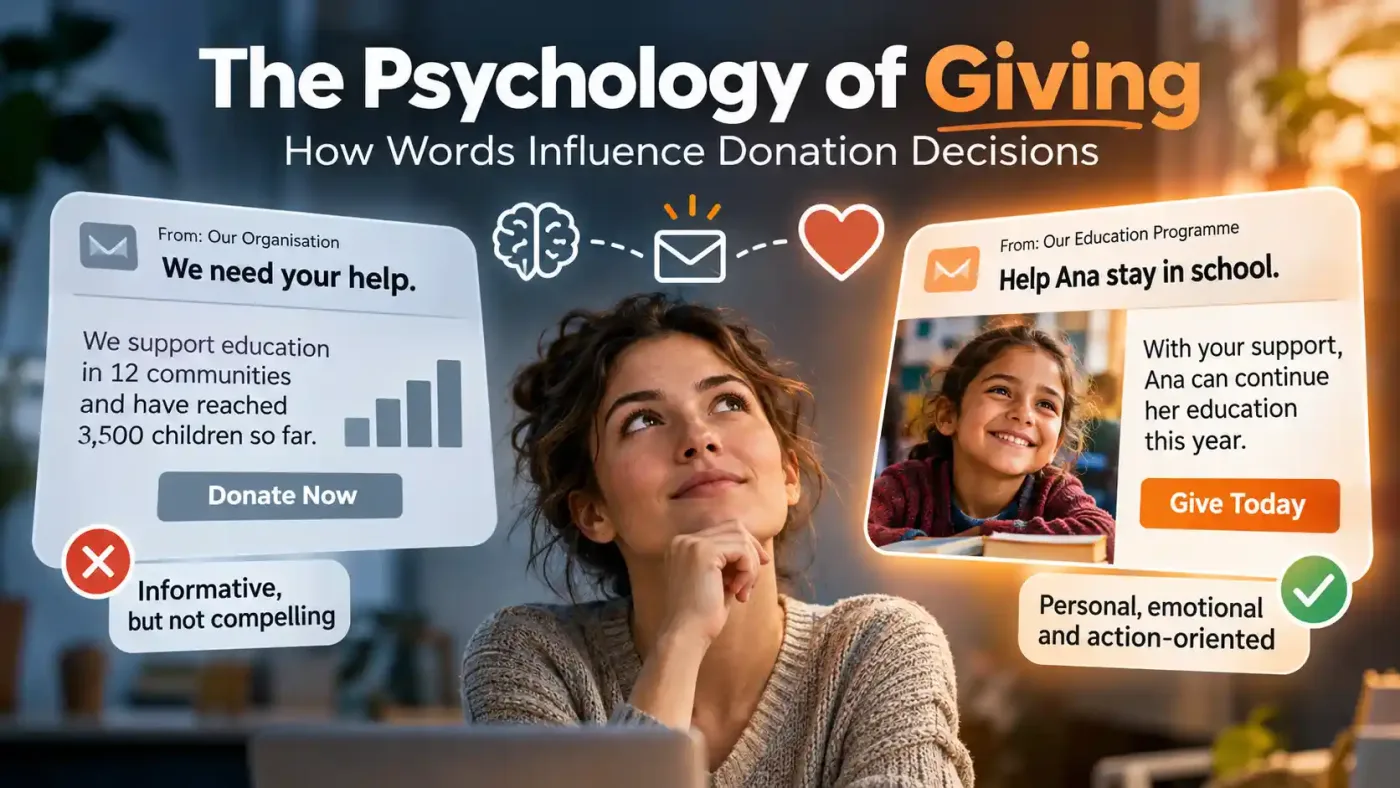
Compare two openings for the same appeal:
Version A: Our organisation supports hundreds of children across the region who lack access to quality education. Your donation will help us continue our important work.
Version B: Amra is ten. In March her village school closed, and the nearest one is a 40-minute walk along the main road. €30 pays for her bus pass until June.
Version B uses most of the principles below. It also raises the questions this article keeps coming back to. Did Amra's family agree to her story being told? Is €30 a real cost? And what happens to the money if more comes in than one bus pass needs?
Amra, the amounts and the organisation in this article's examples are illustrations, not a real case.
Why do people give to charity?
People give for a mix of reasons, and most of them can be reached through words. René Bekkers and Pamala Wiepking, researchers at the Center for Philanthropic Studies at VU Amsterdam, reviewed more than 500 studies in 2011 and grouped the reasons into eight mechanisms: awareness of need, being asked, costs and benefits, altruism, reputation, psychological benefits, values and efficacy. Four of them matter most when you sit down to write an appeal.
| Motive | What research shows | What it means for your copy |
|---|---|---|
| Empathy for a person | Sympathy is strongest for one identified person and weakens as the number grows (Västfjäll et al., 2014) | Lead with one person, then show the wider need |
| Identity and values | People give in ways that fit how they see themselves, and giving shapes that self-image in return (Aaker and Akutsu, 2009) | Write to the donor as someone who already cares about the cause |
| Trust | Donors care where their money goes. In one field experiment, telling people a funder had already covered overhead raised the donation rate by 80% compared with presenting the same money as seed funding (Gneezy, Keenan and Gneezy, 2014); a later replication found weaker results | Say plainly what the gift pays for and what happens to any surplus |
| Seeing impact | Tangible details about a charity's work raise donations, partly because donors believe their own gift will matter more (Cryder, Loewenstein and Scheines, 2013) | Name the item, the service, the result |
One more finding is worth knowing before you pick a lever. In 2024, Bekkers reported preliminary results from a project checking which findings had been replicated since the original review. Research on efficacy, solicitation, material costs and psychological benefits held up better than research on awareness of need, reputation, values and altruism. For anyone writing appeals, that is a useful steer: showing that a gift works stands on firmer ground than describing how large the need is.
Which five psychological principles shape donation decisions?
Five principles do most of the work in fundraising copy: the identifiable victim effect, perceived impact, social proof, reciprocity and urgency. Each has solid research behind it, and each has a point where persuasion turns into manipulation. Below, each principle comes with the evidence, a sample line and the limit.
1. The identifiable victim effect: why one story outweighs a statistic
People give more to help one named person than to help a large anonymous group. In experiments by Deborah Small, George Loewenstein and Paul Slovic (2007), participants who read about Rokia, a seven-year-old girl in Mali, gave an average of $2.38 out of $5. Those who read statistics about hunger in Africa gave $1.14. When the statistics were added to Rokia's story, giving fell to $1.43.
Later work by Daniel Västfjäll and colleagues (2014) found that compassion can begin to fade from the second person onwards. In the same paper, describing several people as one unit reversed the drop.
Sample line: "Amra is ten, and the nearest open school is a 40-minute walk away."
The limit: the story must be real, told with consent, and typical of the people you serve. A composite character has to be labelled as one. Put the wider numbers after the person, framed as one group ("the 24 children in Amra's class"), not as a wall of figures.
2. Perceived impact: showing that the gift matters
Donors give more when they can see what their money will do. Cynthia Cryder and colleagues (2013) found in three experiments that tangible details about a charity's work raised donations, and that the effect ran through donors' sense that their contribution would have an impact. A broad mission makes any single gift feel like a drop in the ocean. A costed item does not.
Sample line: "€30 pays for one child's bus pass from January to June."
The limit: use only amounts your finance lead can back up, and say what happens if you raise more than you need. If the money goes into general funds, "helps pay for" is more accurate than "buys".
3. Social proof: what others are doing
People are more likely to give when they learn that people like them give. In a field experiment at the University of Zurich, Bruno Frey and Stephan Meier (2004) told randomly selected students either that 64% or that 46% of their fellow students contributed to two social funds. The 64% group was more likely to contribute, by roughly two percentage points, and only some students reacted to the information at all.
That size matters. Social proof is real but modest, and it will not rescue a weak appeal.
Sample line: "312 of our neighbours have given to the bus fund this autumn."
The limit: use only counts you can verify, and don't imply a crowd that isn't there. A small honest number ("41 local businesses") is better than a vague large one ("thousands of supporters").
4. Reciprocity and gratitude: what brings donors back
People tend to return a kindness. In a field experiment by Armin Falk (2007), about 10,000 donation letters went out in Switzerland. Letters with one postcard drawn by children received donations 17% more often than letters with no gift, and letters with four postcards 75% more often.
Gratitude is less straightforward than the sector usually assumes. Anya Samek and Chuck Longfield (2023) randomly assigned around 500,000 new donors to US public television stations and a national nonprofit to receive a thank-you call or no call. Fundraising professionals predicted a large rise in retention. The calls had no measurable effect on whether people gave again.
That doesn't make thanking pointless. It means a standard thank-you is not, by itself, a retention strategy. My reading is that what donors learn in the follow-up matters more than the gesture: what their gift did, told specifically.
Sample line: "Your €30 paid for Amra's bus pass. She hasn't missed a day since September."
The limit: small, genuine thanks are fine. Engineering a sense of debt, such as a gift sent with a guilt-heavy ask, is not.
5. Urgency and loss aversion: when timing matters
People weigh losses more heavily than equal gains, a pattern Daniel Kahneman and Amos Tversky described in 1979 as loss aversion. A deadline uses this: it turns "I'll give later" into a decision now. Urgency works, and it has a price. In a field experiment with a charity, Mette Trier Damgaard and Christina Gravert (2018) found that reminder emails raised donations but also substantially increased unsubscribes. In the working-paper version, the net value of each reminder to the charity was about $0.18.
Sample line: "The transport company closes spring orders on 19 December."
The limit: use real deadlines only, and name the reason the deadline exists. Describing a real loss ("her pass runs out") is fair. Inventing one is not. Count unsubscribes as a cost of every urgent send.
| Principle | Use it by | Stop when |
|---|---|---|
| Identifiable victim | Leading with one real person | The story is invented, unconsented or untypical |
| Perceived impact | Naming a costed item or result | No one can back up the number |
| Social proof | Citing a real count of supporters | The crowd is implied, not counted |
| Reciprocity | Thanking with specifics | Thanks are used to create a sense of debt |
| Urgency | Naming a real deadline and its reason | The deadline resets every month |
How do word choices change the way donors read a message?
Small wording choices decide whether a donor sees themselves in the appeal or reads a report about an organisation. Three contrasts matter most: who each sentence is about, how concrete it is, and whether it leaves the reader with fear alone or with something they can do.
Organisation-centred vs donor-centred language
Organisation-centred copy makes the charity the subject ("We provide", "Our programme"). Donor-centred copy makes the reader the one who acts ("Your gift", "You can"). The goal is not to count how many times "you" appears. It is to make clear what the reader can change.
Abstract vs concrete
"Access to education" is abstract. "A bus pass" is concrete. Cryder's research suggests concrete detail raises giving because it makes impact believable.
| Generic copy | Clearer alternative | What changed |
|---|---|---|
| We need your support. | €30 pays for one child's bus pass until June. | A costed item replaces a need |
| Donate to our organisation. | Pay for a bus pass for one of the 24 children in Amra's class. | The gift goes to a result, not an institution |
| Our project was successful. | All 24 children got to school every day this term. Here's what that took. | A measurable outcome replaces a verdict |
| Please give today. | Spring passes have to be ordered by 19 December. | A reason for the timing replaces a plea |
| Help us reach our education funding goal. | We need €720 for 24 passes. We have €410. | Progress toward a concrete target replaces "our goal" |
The last row deserves a note. "Help us reach our goal" is a common donor-centred rewrite that is still about the organisation. None of these alternatives is guaranteed to raise more money. They are clearer, and clarity is what you then test.
Fear-based vs hope-based messaging
The evidence here is less tidy than most advice suggests. Deborah Small and Nicole Verrochi (2009) found that charity flyers showing a child with a sad face led more participants to donate (about 78%) than flyers with a happy or neutral face (about 53%). Later studies have produced mixed results, depending on the audience and how the image is used.
So the honest answer is not "always use hope". Sadness can be part of a true story. What crosses the line is showing people only as helpless, or using distress to get a reaction. Show the problem, show what the person is doing about it, and show what the gift changes.
How can a story connect without exploiting the person in it?
A story connects without exploiting when the person in it agreed to it, would recognise themselves in it, and appears as someone with their own goals rather than as an object of pity. The Dóchas Guide to Ethical Communications (2023), written by and for Irish development NGOs, puts the dignity of the people portrayed first. It is a good working standard for any organisation.
Four habits make this practical:
- Consent before publication. Record it, in a language the person understands, with a clear way to withdraw it later. For children, consent comes from a parent or guardian, and the child's own view should be heard if they are old enough to give it. In the EU and many neighbouring countries, a recognisable photo and a personal story are personal data, so check what your data protection law requires.
- Protect identity wherever there is risk. Change names, leave out school names and exact locations, and avoid recognisable photos of children in sensitive situations. Say in the appeal that the name has been changed.
- Give people agency. Use their own words where you can, and show what they are doing, not only what they lack. "Amra wants to be a vet" tells the reader more than "Amra has nothing".
- Put evidence next to the story, not on top of it. Small's experiments suggest that piling statistics onto a personal story can lower giving. Tell the story first, then add one verified figure that shows it is not an isolated case.
How do you write a call to action that respects donors?
A respectful call to action tells the donor exactly what happens when they click, ties the gift to a specific purpose, and leaves them free to say no. Pressure lines such as "now or never" or "don't let her down" may raise clicks once. They also teach supporters to distrust your next email.
Five examples for emails and donation pages:
- Pay for one bus pass: €30
- Give €10 a month to the homework club, with "Cancel any time from your account" under the button
- Join the 312 neighbours who gave this autumn, only with a real count
- See where last year's gifts went, then decide, for lapsed donors
- Give €30 now, with this line below it: "If we raise more than we need, the extra funds the homework club for the same children."
What does a weak appeal look like after a rewrite?
The example is hypothetical. A small education NGO runs an after-school programme and needs to fund bus passes for children whose village school has closed.
Before
Subject: Support our education programme
Dear Friend,
For over 15 years, our organisation has worked to improve education in our community. This year we face many challenges, and our needs are greater than ever. We need your support to continue our important work. Every donation, big or small, makes a difference. Please give today.
[Donate]
After
Subject: Amra's bus pass runs out on 19 December
Dear Ana,
Amra is ten. In March her village school closed, and the nearest one is a 40-minute walk along the main road. Since September she has gone by bus, paid for by supporters like you, and she hasn't missed a day.
Her pass runs out on 19 December, and so do the passes of the other 23 children in her class. That is also the day the transport company closes its orders for spring.
€30 covers one child's bus pass from January to June. We need €720 for all 24, and we have €410 so far.
[Pay for one bus pass: €30]
If we raise more than €720, the extra will go to the homework club the same children attend. We'll write to you in January to tell you how many passes we bought.
Thank you for getting Amra this far.
Milica, programme coordinator
Amra's name has been changed. Her mother agreed to us sharing her story.
Why it changed
| Principle | Where it appears in the rewrite |
|---|---|
| Identifiable victim | One named child, then the class described as one group of 24 |
| Perceived impact | €30 for one pass for one term, a €720 target, €410 raised so far |
| Reciprocity | Opens with what earlier gifts achieved, ends with thanks and a promised report |
| Urgency | A real deadline with a stated reason, the transport company's order date |
| Trust | The surplus rule is stated, consent is noted, and a named person signs |
What the rewrite leaves out matters as much. There is no "last chance", no photo of a crying child, no claim that Amra's future depends on this one reader, and no national statistic on school closures stacked on top of her story.
How can you tell whether your fundraising copy works?
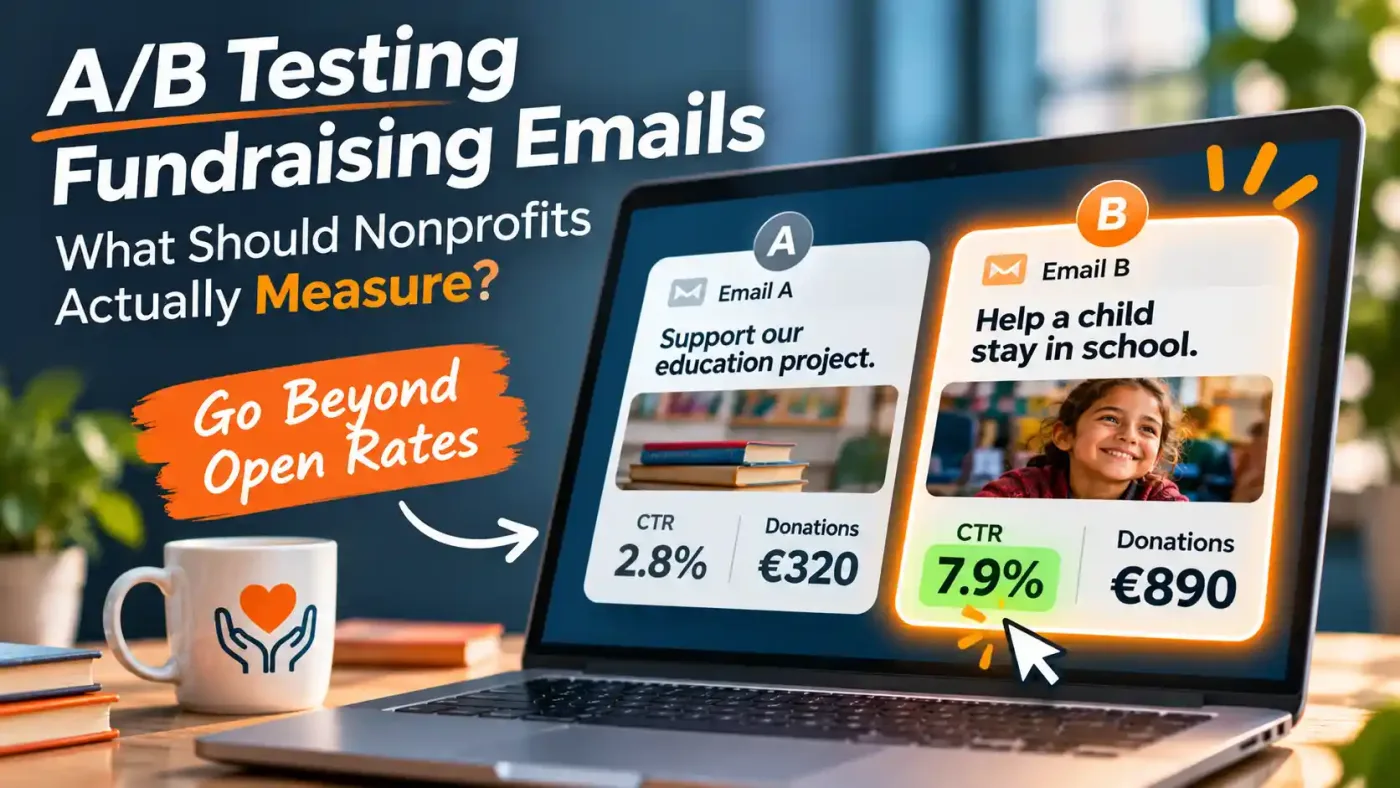
Judge copy by clicks to the donation page, completed gifts and revenue, and count unsubscribes as a cost next to them. Don't rely on opens, which Apple's Mail Privacy Protection inflates. On a small list, one send rarely gives a clear answer, so run the same comparison across several appeals.
Two tests are worth running first. Compare an emotional opening with an informational one: in a 2020 study, Matthew Lindauer and colleagues found that a well-built rational argument for giving did as well as the Rokia appeal, so don't assume emotion always wins with your supporters. Then ask five recent donors, by phone or a short email, what made them give. Their words often make better copy than yours.
The A/B testing article in this series covers the method, and the subject line article explains why a small list needs several sends before a pattern can be trusted.
What should you check before an appeal goes out?
Every appeal has two readers: the donor who receives it and the person whose story it tells. I call this check the Two Readers Test. An appeal passes when both would accept it if they knew exactly how it was made.
| Reader | Question | Fails when |
|---|---|---|
| Donor | Is every fact true and current: the amount, the deadline, the count, the result? | Any figure can't be backed up from your records |
| Donor | Would the donor feel tricked if they saw how the appeal was built? | The urgency is invented or the surplus rule is hidden |
| Person in the story | Did they, or their guardian, agree to this use of their story? | There is no recorded consent for this channel |
| Person in the story | Would they recognise themselves and feel respected? | They appear only as helpless, or could be identified when they shouldn't be |
If an AI tool drafted the appeal, run the test with extra care. Language models write moving stories and tidy impact figures with ease, whether or not they are true. The rule I use for grant writing applies here too: a person who can vouch for the facts signs off before anything goes out.
My view: impact is the most underused lever
A lot of fundraising copy reaches for emotion first. In my view, the more underused lever is perceived impact. Small teams usually know exactly what €30 buys and what happened to last term's gifts, and they still write "every donation makes a difference". The replication results point the same way: research on efficacy has held up better than research on awareness of need.
The thank-you call study is the other lesson I would keep. Experienced fundraisers predicted a large effect and there was none. That should make all of us, me included, less sure about what "everyone knows" works with donors. Test what you can. Where you can't, choose the version that passes the Two Readers Test.
What to do next
- Take your last appeal and underline every concrete detail: a name, an amount, a date, a result. If there are fewer than three, rewrite the first paragraph before the next send.
- Ask your finance lead to cost three items or services donors can fund, and agree in writing what happens to any surplus.
- Set up a consent form for stories and photos that records the channel, the date and how to withdraw. Check the stories you already use against it.
- Add unsubscribes to the results you track for every fundraising send.
- Run the Two Readers Test on your next appeal with one colleague who didn't write it.
Effective fundraising begins with trust
When appeals underperform, teams often reach for stronger emotion or more urgency. The research points elsewhere. Donors respond to appeals that make the effect of their gift visible and believable, and they leave when they feel pushed or misled. Psychology helps you write an appeal people act on. Trust is what gets the next one read.
About the author
Milan Bogojević writes about fundraising, grant strategy and practical AI for small and mid-size nonprofits on milanbogojevic.com.
Last updated
10 November 2026 - First published.
Questions people ask about this
What is the psychology behind charitable giving?
People give for several overlapping reasons: they see a need, someone asks them, they believe their gift will help, giving feels good, and it fits their values and sense of who they are. A review of more than 500 studies by Bekkers and Wiepking (2011) grouped these into eight mechanisms. For fundraising copy, the most practical are making the need concrete and showing that a gift works.
How does empathy influence donation decisions?
Empathy makes people more willing to give, and it is strongest for one identifiable person. In experiments by Small, Loewenstein and Slovic (2007), people gave about twice as much to help one named girl as they did after reading statistics about millions in need. Empathy fades as numbers grow, so lead with one real person, told with consent, and describe the wider need as one group rather than a list of figures.
What makes fundraising copywriting effective?
Effective fundraising copy is specific, true and clear about what the reader can do. It names a person or a result, says what a set amount pays for, gives a real reason for the timing, and makes the next step obvious. It also protects trust: no invented urgency, no hidden conditions, and a report back on what the money did. Judge it by clicks, gifts and unsubscribes, not opens.
Do emotional appeals work better than statistics?
Not always. A story about one person often raises more than statistics alone, and adding statistics to a story can lower giving. But a 2020 study by Lindauer and colleagues found that a well-constructed rational argument did as well as a classic emotional appeal. The safest approach is a real story first, followed by one verified figure, and a test of both versions with your own supporters.
How can nonprofits use psychology ethically?
Use psychological principles to make true information easier to act on, not to create feelings the facts don't support. That means real stories with consent, costed amounts, real deadlines with reasons, accurate supporter counts and thanks that report results. A simple check is whether both the donor and the person in the story would accept the appeal if they knew exactly how it was made.
Where this comes from
- Bekkers and Wiepking (2011). A Literature Review of Empirical Studies of Philanthropy: Eight Mechanisms That Drive Charitable Giving doi.org
- Bekkers (2024). Eight Mechanisms, Seventeen Years Later renebekkers.wordpress.com
- Small, Loewenstein and Slovic (2007). Sympathy and Callousness doi.org
- Västfjäll, Slovic, Mayorga and Peters (2014). Compassion Fade doi.org
- Cryder, Loewenstein and Scheines (2013). The Donor Is in the Details doi.org
- Frey and Meier (2004). Social Comparisons and Pro-social Behavior doi.org
- Falk (2007). Gift Exchange in the Field doi.org
- Samek and Longfield (2023). Do Thank-You Calls Increase Charitable Giving? doi.org
- Damgaard and Gravert (2018). The Hidden Costs of Nudging doi.org
- Kahneman and Tversky (1979). Prospect Theory: An Analysis of Decision under Risk doi.org
- Small and Verrochi (2009). The Face of Need doi.org
- Gneezy, Keenan and Gneezy (2014). Avoiding Overhead Aversion in Charity doi.org
- Aaker and Akutsu (2009). Why Do People Give? The Role of Identity in Giving doi.org
- Lindauer et al. (2020). Comparing the Effect of Rational and Emotional Appeals on Donation Behavior doi.org
- Dóchas (2023). Guide to Ethical Communications dochas.ie