Why Your Fundraising Email Subject Line Matters More Than You Think
A fundraising email subject line decides whether your appeal gets read at all, and it tells the donor what to expect before they see a single sentence of your story. That makes it more than a headline. It is a small promise. When the subject line is specific, honest about why you are writing today, and kept by the email underneath it, supporters open, read and act. When it is vague, inflated or built on guilt, it may win one open and quietly cost you their attention for the rest of the year.
The email your donor never opened
Picture a small community organisation (a hypothetical one) with three staff and 4,000 people on its email list. In November it launches a winter appeal for its youth centre. The programme lead has written a genuinely good story about a teenager who now comes in four afternoons a week. The donation page loads quickly. The email goes out with the subject line "Our Winter Appeal 2026".
A week later, two gifts have come in. The team starts asking the usual questions. Was the story too long? Was the ask too high? Was it the wrong week?
Those are fair questions, but they skip a step. The story only works on people who read it, and the subject line was the only part of the email that everyone on the list actually saw. "Our Winter Appeal 2026" is what the organisation calls the campaign internally. It gives a supporter no reason to stop scrolling.
So was the subject line the problem? Partly, perhaps. But as you will see further down, two gifts from 4,000 emails is also roughly what the sector average predicts, and that is its own lesson about how to judge a subject line.
Why do subject lines matter so much in nonprofit fundraising?
The subject line is the one part of a fundraising email that every recipient sees, usually wedged between dozens of other messages. It decides whether the appeal gets read, it frames what the reader expects inside, and over months it teaches supporters whether your emails are worth their time. That cumulative effect is why a subject line matters more than any single campaign report suggests.
The first impression in a crowded inbox
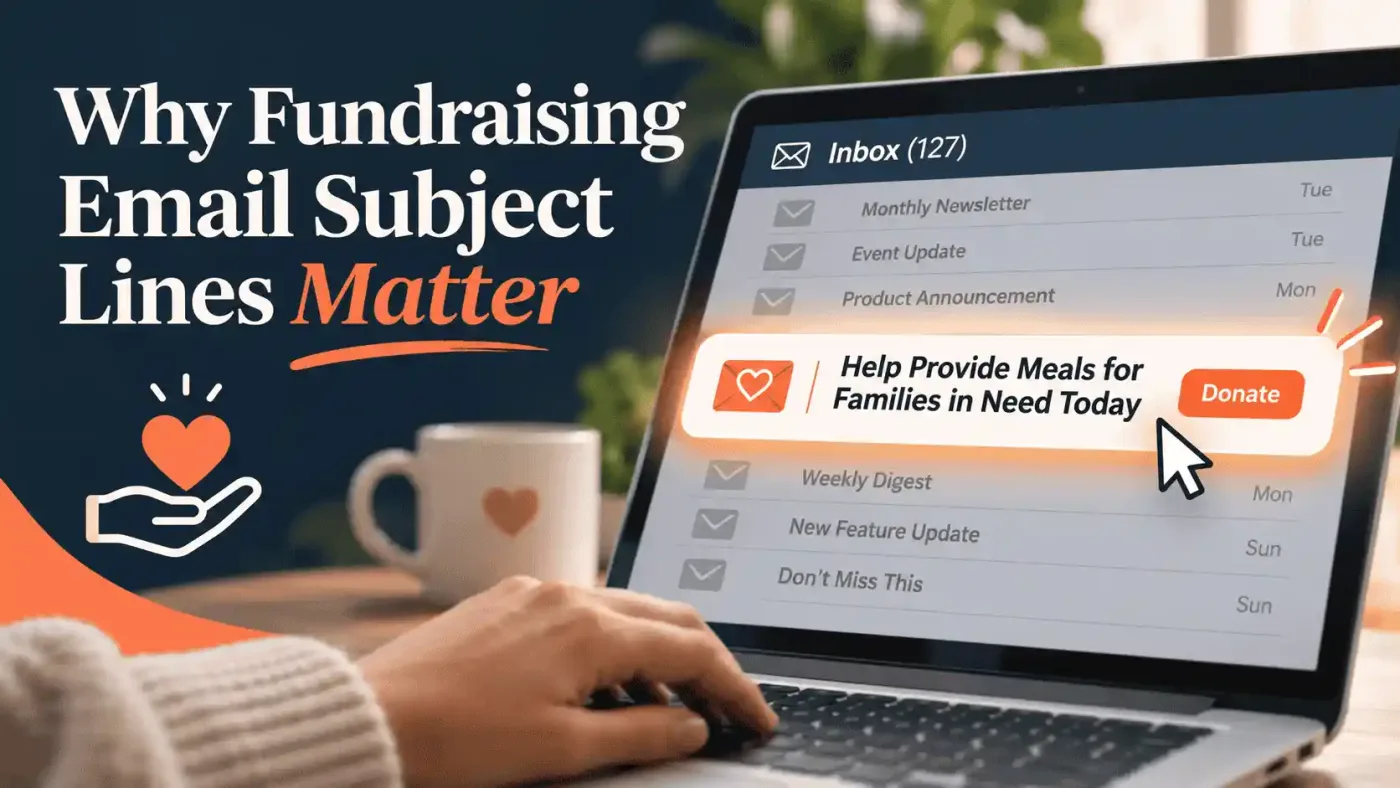
Your appeal is not only competing with shops, banks and other charities. It is competing with you. According to the M+R Benchmarks 2026 study, the average subscriber on a nonprofit email list received 50 emails from that one organisation in 2025, and 31 of them were fundraising appeals.
That changes what a subject line has to do. A label like "Newsletter" or "Winter Appeal" doesn't just blend into the inbox. It blends into your own last twenty sends. The subject line has to tell a supporter why this email is different from the one they ignored on Tuesday.
The relationship between subject lines and donor trust
Every subject line is a claim about what the email contains. When the email delivers, the next subject line gets a little more benefit of the doubt. When it doesn't (a "Quick question" that opens straight into a donation ask), supporters learn to discount what you write.
That learning shows up in numbers you can see. M+R found that nonprofits lost 12% of the subscribers they had at the start of 2025 to unsubscribes during the year. Some people will leave whatever you do. Spam complaints are the sharper warning. Google's email sender guidelines ask senders to keep the spam rate reported in Postmaster Tools below 0.3%, and a subject line that feels like a trick gives a supporter a reason to reach for the spam button rather than the unsubscribe link.
There is a regulatory side too. In the UK, the Fundraising Regulator's Code of Fundraising Practice, revised in 2025, expects fundraisers not to mislead people and not to put undue pressure on anyone to donate. In the US, the CAN-SPAM Act requires a subject line to accurately reflect the content of the message. That rule is aimed mainly at commercial email, so most charity appeals fall outside it, but it is still a good test to borrow.
Why open rates don't tell the whole story
Most teams judge a subject line by its open rate, and that number has become unreliable. Apple Mail Privacy Protection, introduced in late 2021, preloads messages for many Apple Mail users, which can register an open whether or not a person ever looked at the email. M+R stopped reporting open rates in its Benchmarks study for this reason. Among participants who could separate machine opens from human ones, 64% of all opens were machine opens.
So a subject line test judged on opens can crown the wrong winner. And even a genuine open is only a step. The numbers that matter for an appeal are much smaller: across M+R's participants, fundraising emails averaged a 0.59% click-through rate, a 0.05% response rate and $54 for every 1,000 emails sent in 2025. Judge a subject line by what happens after the open.
What makes a donor decide to open a fundraising email?
Donors open a fundraising email when the subject line gives them a reason that connects to something they already care about, from a sender they recognise. Four levers do most of the work: curiosity, emotion, a reason to act now, and relevance. Each has an honest version and a manipulative one. For a charity that depends on long-term trust, the difference matters far more than it does for a shop running a weekend sale.
Curiosity without clickbait
Curiosity works when the subject line opens a real question and the email answers it. "Why our breakfast club is full every morning" makes a supporter wonder, and the email can tell them.
Clickbait withholds or misrepresents. "You won't believe this", a "Re:" on an email that isn't a reply, or "Quick question" on an appeal all get the open by hiding what the email is. The check is simple: after opening, would the donor feel they got what the subject line suggested? If they would feel tricked, rewrite it.
Emotion and human connection
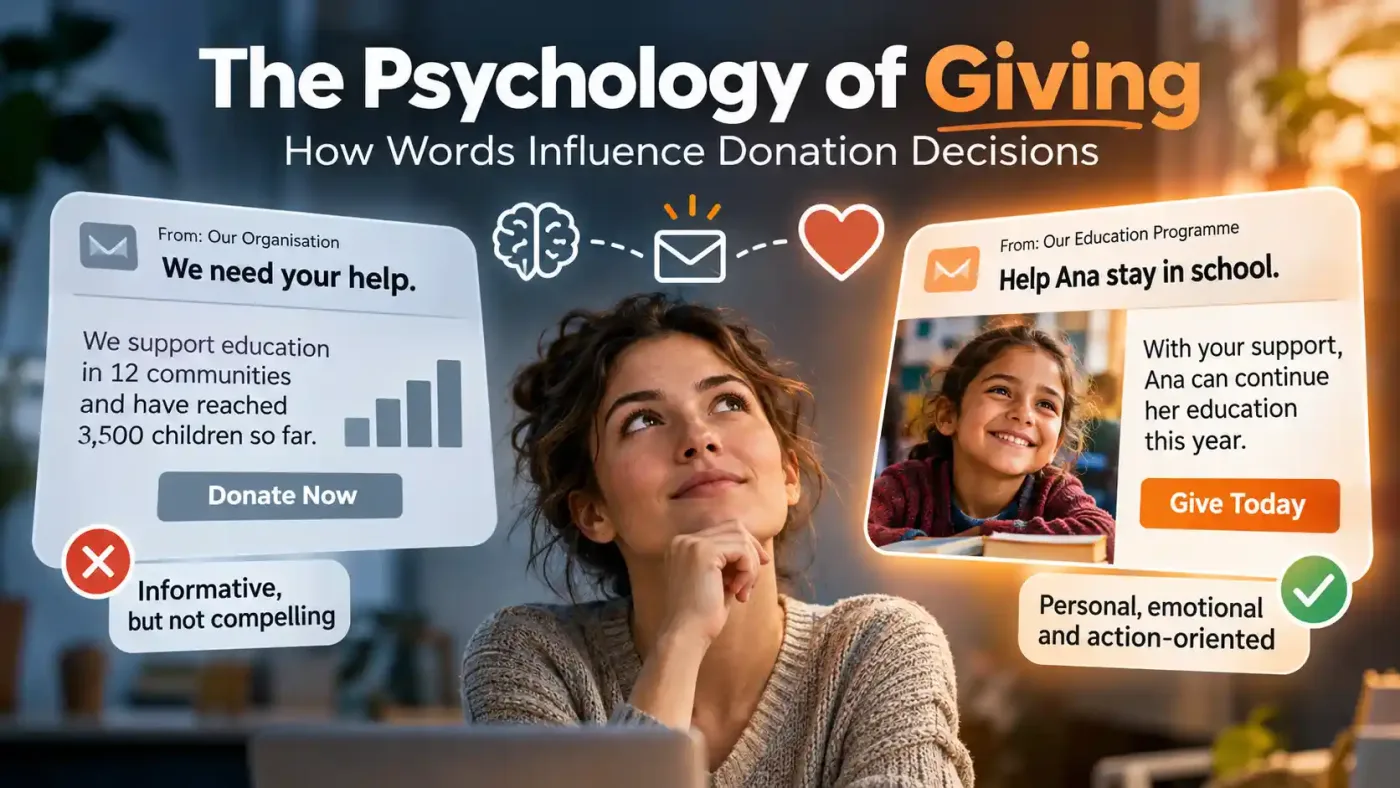
People give because they feel something, so emotion belongs in fundraising. Subject lines that point to a person, a place or a change usually connect better than abstractions like "Support our mission".
The trouble is space. A subject line has room for a few words and no context, and that is where emotion slides into pity or stereotype. Concrete, respectful detail travels better: what changed, where, and who made it happen. One more line worth holding: a beneficiary's story belongs to them. Don't put a real person's name in a subject line unless they have agreed to be named in fundraising, and be stricter still when your work involves children or people at risk.
Urgency without manipulation
Urgency works, and pretending otherwise helps nobody. M+R's 2026 Scout AI analysis of five years of email from 12 nonprofits linked urgency language to a 48% higher click-through rate, as summarised by RKD Group.
The real question is whether the urgency is true. A match that ends on Friday, a funder's deadline, the first cold week of winter: those are reasons to act now. "LAST CHANCE" on the fourth of five last-chance emails, a deadline invented for the campaign calendar, or a countdown that quietly resets next month are not. Supporters notice, and pressure of that kind is exactly what the UK Code warns against.
My rule is simple: if you can't name the deadline and the reason for it, the email isn't urgent.
Personalisation and relevance
The evidence on putting a donor's first name in the subject line is more mixed than most guides admit. In a 2018 field experiment published in Marketing Science, adding the recipient's name raised the chance of opening by about 20%, from roughly 9% to 11%, for an online test-preparation company. A 2023 replication in Marketing Letters found no effect of the first name on opens or clicks. M+R's Scout AI analysis linked names in subject lines to a 21% higher response rate across its 12 nonprofits.
Read together, a first name can help, but it is a weak lever and it may be fading now that everyone uses it. Relevance is stronger and harder to copy. "Your September gift: where it went", sent only to people who gave in September, is personal in a way a merge field never is. If you do use names, set a fallback, because a blank or misspelled name does more harm than no name at all.
Five common fundraising subject line mistakes
Most weak fundraising subject lines fail in one of five ways: they are generic, they claim urgency that isn't real, they try to say too much, they hide why the email was sent, or they use emotion to pressure rather than to connect. All five can be fixed in a few minutes, and each maps to one check in the Promise Test further down.
- Generic subject lines. "Newsletter", "Our Winter Appeal 2026", "Support our work". These are internal labels. They tell the reader what you call the email, not why they should open it.
- Excessive urgency. Capital letters, three exclamation marks, and a "final reminder" followed by another one. Used often enough, urgency stops meaning anything, and supporters start skipping everything that looks like it.
- Too much text. "Winter update: new volunteers, our December events and how you can help families this season" is trying to be three emails. M+R's Scout AI analysis associated each extra word in a subject line with about 7% lower response. Pick one idea and put the important words first, because mail apps on phones often cut long subject lines short.
- An unclear reason for sending. "Checking in", "Quick question", or a fake "Re:". The donor can't tell whether this is a thank-you, a report or an ask, and the ones who open it to find an ask feel misled.
- Manipulative emotional language. "Without you, these children will go hungry tonight." Guilt can move a gift once. It also puts the donor at the centre of someone else's hardship, flattens the people you serve into victims, and wears supporters out.
How do you write a better fundraising subject line?
Start from what the donor cares about, name one specific thing that changes, make sure the first lines of the email deliver what the subject line promised, and test in a way your list size can actually support. Write several options for every important send. The first one you write is usually the one closest to your internal campaign name.
Start with the donor, not the organisation
Look at your last ten subject lines and count how many start with "Our" or "We". Shifting the point of view is often enough. "Our autumn update" becomes "What your gifts built at the youth centre this autumn". Not every subject line needs the word "you", but every one should answer the reader's question: why does this matter to me?
Make the impact specific
Specific beats general almost every time: a number, a place, a time, a named programme. "Help families in need" could come from any charity. "€25 covers a week of school lunches for one child" could only come from yours, provided it is true. Take figures from your own budget or programme reports and check them before every send. A specific claim that turns out to be wrong does more damage than a vague one.
Align the subject line with the email content
The subject line, the preview text and the first two or three lines of the email should read as one thought. If the subject line promises the story of the breakfast club, the email opens with the breakfast club, not with a paragraph about your organisation's history. Use the preview text to extend the subject line, not to repeat it.
Test different approaches
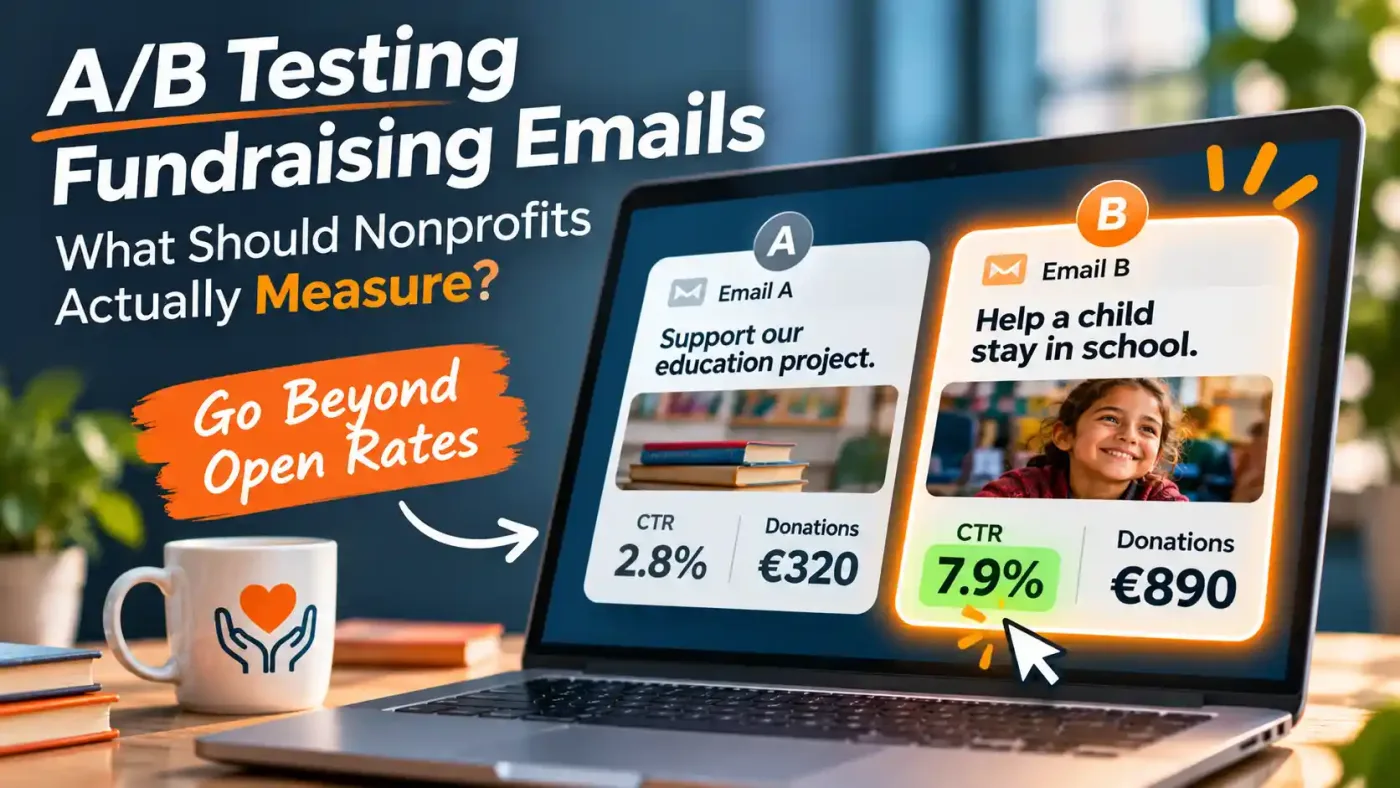
A/B testing is the standard advice, and it is sound for large lists. For a small nonprofit, the arithmetic is unforgiving. At the M+R average response rate of 0.05%, an email to 4,000 people produces about two gifts. Split that list in two for a test and each version gets roughly one gift. No test can tell you anything from that.
Clicks are thin as well: at 0.59%, each half of a 4,000-person list produces around a dozen. So test big differences rather than small wording changes, compare clicks rather than gifts, repeat the same kind of test across several sends, and keep a simple log of what you tried and which way it went. A pattern that holds across five appeals is worth more than one "winner".
If you use an AI tool to draft subject line variants, read each one against the email before it goes out. These tools are good at producing options that get opened. They carry no responsibility for whether the email keeps the promise. That judgement stays with a person, for the same reasons set out in what AI should never decide in grant writing.
Before-and-after examples of fundraising subject lines
| Weak subject line | Better subject line | What changed |
|---|---|---|
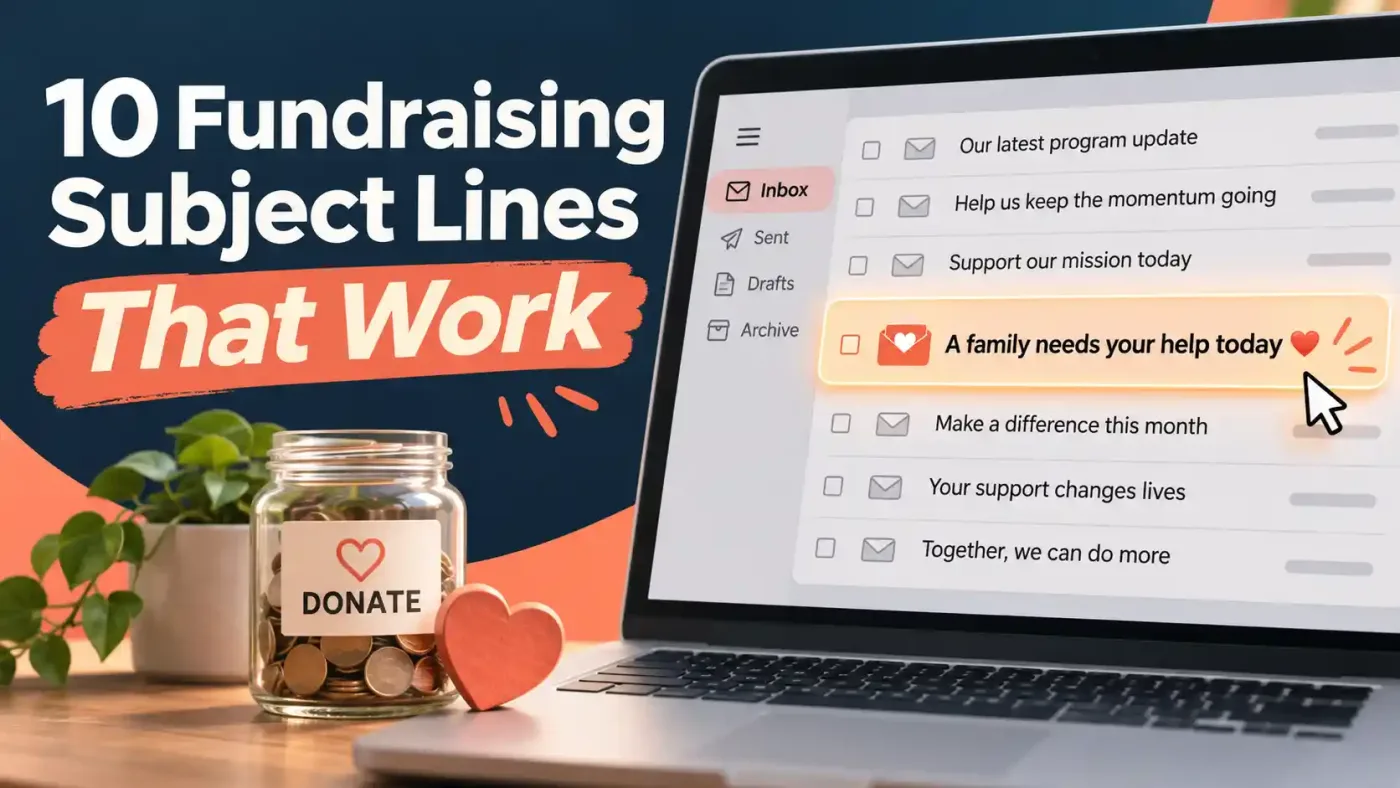
| Our Winter Appeal 2026 | Keeping the youth centre warm this winter | Names the concrete need instead of the internal campaign label. |
| URGENT!!! Last chance to give | Your gift is matched until Friday at midnight | Uses urgency only because a real match exists, and says when it ends. |
| Winter update: new volunteers, December events and how you can help families this season | 12 families have a stable home this autumn | One idea, readable at a glance, with the result first. |
| Quick question | Your September gift: where it went | Says why the email was sent. Going only to September donors, it is relevant as well as clear. |
| Without you, these children will go hungry tonight | Why our breakfast club is full every morning | Swaps guilt for curiosity and lets the email show the children as people, not as a threat. |
The figures and programmes in these examples are illustrative. Replace them with your own, and only with numbers you can back up.
How do you check a subject line before you send it?
Run it through five quick checks. I call it the Promise Test, because a subject line is a promise the email has to keep. It takes about a minute per send and catches each of the five mistakes above.
| Check | Question to ask | It fails when | Prevents |
|---|---|---|---|
| Clear | Would a supporter know why this email arrived today? | It could be a thank-you, a report or an ask | Unclear reason |
| Specific | Does it name one person, place, result or deadline? | It could have come from any charity | Generic subject lines |
| True and kept | Is every claim true today, and do the first lines of the email deliver it? | The urgency is invented, or the email is about something else | Excessive urgency |
| Short | Can it be understood in one glance, with the key words first? | It holds more than one idea | Too much text |
| Dignified | Would the people it describes be comfortable reading it? | It leans on guilt, pity or someone's story without consent | Manipulative emotion |
A subject line that passes all five can still lose a test. But it won't cost you trust while it does.
How do you measure whether a subject line works?
Judge a subject line by what happens after the open: clicks, gifts and revenue per delivered email, with unsubscribes and spam complaints as the cost. Treat open rate as a rough sign that your emails are reaching inboxes, not as proof that anyone read them.
| Metric | How to calculate it | What it tells you | Watch out for |
|---|---|---|---|
| Open rate | Unique opens ÷ delivered emails | Whether emails are landing in inboxes | Inflated by machine opens. Don't pick test winners on it. |
| Click-through rate | Unique clicks ÷ delivered emails | Whether subject line and email together got people to act | Some platforms divide by opens instead. Check which one you're looking at. |
| Donation conversion rate | Gifts ÷ delivered emails | Whether the appeal turned readers into donors | Tiny numbers on small lists. Look across several sends. |
| Revenue per delivered email | Revenue ÷ delivered emails (× 1,000 to compare with benchmarks) | What each email is actually worth | One large gift can distort a single send. |
| Unsubscribe and spam complaint rate | Unsubscribes or complaints ÷ delivered emails | The cost in trust | A rise after a "clever" subject line is a warning sign. |
For reference, M+R's 2026 figures for fundraising email were a 0.59% click-through rate, a 0.05% response rate and $54 per 1,000 emails sent. The organisation in the opening example, with two gifts from 4,000 emails, was close to average. Its subject line was weak, but one send could never have proved it.
My view
I see the subject line less as a copywriting trick and more as a running account of trust. Each send adds a little or takes a little away. The subject line that wins a single test is not always the one that serves the programme, because the cost of a clever trick shows up months later, in a supporter who no longer opens anything.
For small teams, my advice is to stop chasing open rates altogether. Write subject lines that are clearer and truer, judge them by clicks and gifts over a season, and keep the people in your stories in mind while you write. My working rule: if a subject line would embarrass you in front of the person it describes, or in front of the donor once they have opened the email, don't send it.
What to do next
- Copy the subject lines of your last ten fundraising emails into a spreadsheet. Next to each, add clicks, gifts, revenue per 1,000 delivered and unsubscribes. Leave opens out.
- Run each subject line through the Promise Test and rewrite the two weakest, even though those emails have already gone.
- For your next appeal, write eight subject lines before you choose one, and read the shortlist on your phone rather than on a laptop.
- If your email platform resends to "non-openers", check whether it counts machine opens. If it does, that resend list is missing many of the people you meant to reach.
- Start a subject line log: one line per send, recording what you tested and which way it went. Review it after six appeals.
A better subject line is only the beginning
When an appeal underperforms, teams tend either to blame the subject line for everything or to treat it as an afterthought. Both get it wrong. A subject line can't rescue a weak story, an unclear ask or a slow donation page, and it can't be judged on one send to a small list. What it can do is bring a supporter to the first sentence with their trust intact.
So treat each one as a promise, and make sure the next two hundred words keep it.
Next: 10 Fundraising Email Subject Lines That Make Donors Want to Open [PROVERITI POSTOJEĆI INTERNAL LINK]
Questions about fundraising email subject lines
How long should a fundraising email subject line be?
Short enough to be understood at a glance, with the meaningful words first. There is no universal ideal length, and most published "perfect length" figures come from vendors measuring opens. M+R's Scout AI analysis of 12 nonprofits associated each additional word with about 7% lower response, which supports cutting rather than adding. Write the subject line, then remove every word that doesn't change its meaning.
Does personalisation help fundraising emails?
Sometimes, and less than most guides claim. Adding a first name raised opens by about 20% in a 2018 field experiment, but a 2023 replication found no effect at all. Relevance based on what a donor has actually done, such as their last gift or the programme they support, is a more reliable kind of personalisation than a name field. If you use names, always set a fallback for missing ones.
Should fundraising emails use emojis?
Rarely, if at all. There is little independent evidence that emojis help fundraising emails, and most published claims come from email vendors. Screen readers read emojis aloud by name, so a heart can turn into the words "red heart" in the middle of your subject line. If you test one, keep it relevant to the content, and leave emojis out of appeals about crisis, illness or loss.
Should a fundraising email come from a person or from the organisation?
Test it on your own list, because the evidence points both ways. M+R's Scout AI analysis linked emails sent from a person to a 32% lower response rate, while NextAfter has published tests where a personal sender name lifted opens and clicks. Whichever you choose, use a sender name supporters recognise and keep it consistent, because donors read the sender and the subject line together.
Sources
- M+R, Benchmarks 2026: Email Messaging (2025 data)
- M+R, Benchmarks 2025: Key Findings (open rates and machine opens)
- M+R, What AI "saw" in 3.8 billion nonprofit emails (Scout AI white paper, 2026), figures as summarised by RKD Group
- Sahni, Wheeler and Chintagunta, Personalization in Email Marketing: The Role of Noninformative Advertising Content, Marketing Science 37(2), 2018
- Defau and Zauner, Personalized subject lines in email marketing, Marketing Letters 34(4), 2023
- Google, Email sender guidelines
- Fundraising Regulator, Code 2025 frequently asked questions
- Federal Trade Commission, CAN-SPAM Act: A Compliance Guide for Business
- NextAfter, How to Write Fundraising Email Subject Lines Your Donors Will Open
Last updated
10 November 2026: Article first published.
Questions people ask about this
How long should a fundraising email subject line be?
Short enough to be understood at a glance, with the meaningful words first. There is no universal ideal length, and most published "perfect length" figures come from vendors measuring opens. M+R's Scout AI analysis of 12 nonprofits associated each additional word with about 7% lower response, which supports cutting rather than adding. Write the subject line, then remove every word that doesn't change its meaning.
Does personalisation help fundraising emails?
Sometimes, and less than most guides claim. Adding a first name raised opens by about 20% in a 2018 field experiment, but a 2023 replication found no effect at all. Relevance based on what a donor has actually done, such as their last gift or the programme they support, is a more reliable kind of personalisation than a name field. If you use names, always set a fallback for missing ones.
Should fundraising emails use emojis?
Rarely, if at all. There is little independent evidence that emojis help fundraising emails, and most published claims come from email vendors. Screen readers read emojis aloud by name, so a heart can turn into the words "red heart" in the middle of your subject line. If you test one, keep it relevant to the content, and leave emojis out of appeals about crisis, illness or loss.
Should a fundraising email come from a person or from the organisation?
Test it on your own list, because the evidence points both ways. M+R's Scout AI analysis linked emails sent from a person to a 32% lower response rate, while NextAfter has published tests where a personal sender name lifted opens and clicks. Whichever you choose, use a sender name supporters recognise and keep it consistent, because donors read the sender and the subject line together.
Where this comes from
- M+R, Benchmarks 2026: Email Messaging (2025 data) mrbenchmarks.com
- M+R, Benchmarks 2025: Key Findings (open rates and machine opens) 2025.mrbenchmarks.com
- M+R, What AI "saw" in 3.8 billion nonprofit emails (Scout AI white paper, 2026) www.mrss.com
- RKD Group, Rossi's Roundup: Benchmarks, behavior and the reality behind revenue blog.rkdgroup.com
- Sahni, Wheeler and Chintagunta, Personalization in Email Marketing: The Role of Noninformative Advertising Content, Marketing Science 37(2), 2018 econpapers.repec.org
- Defau and Zauner, Personalized subject lines in email marketing, Marketing Letters 34(4), 2023 link.springer.com
- Google, Email sender guidelines support.google.com
- Fundraising Regulator, Code 2025 frequently asked questions www.fundraisingregulator.org.uk
- Federal Trade Commission, CAN-SPAM Act: A Compliance Guide for Business www.ftc.gov
- NextAfter, How to Write Fundraising Email Subject Lines Your Donors Will Open www.nextafter.com