AI should never decide what a grant application's numbers say, who counts as a programme participant, or whether a result is strong enough to report. It can draft language, reformat a budget, or summarise a document. The moment a sentence makes a factual claim about your organisation's own results, a named person has to check it against the source data before it goes out, every time, not just the first time.
Why this matters for a small nonprofit team
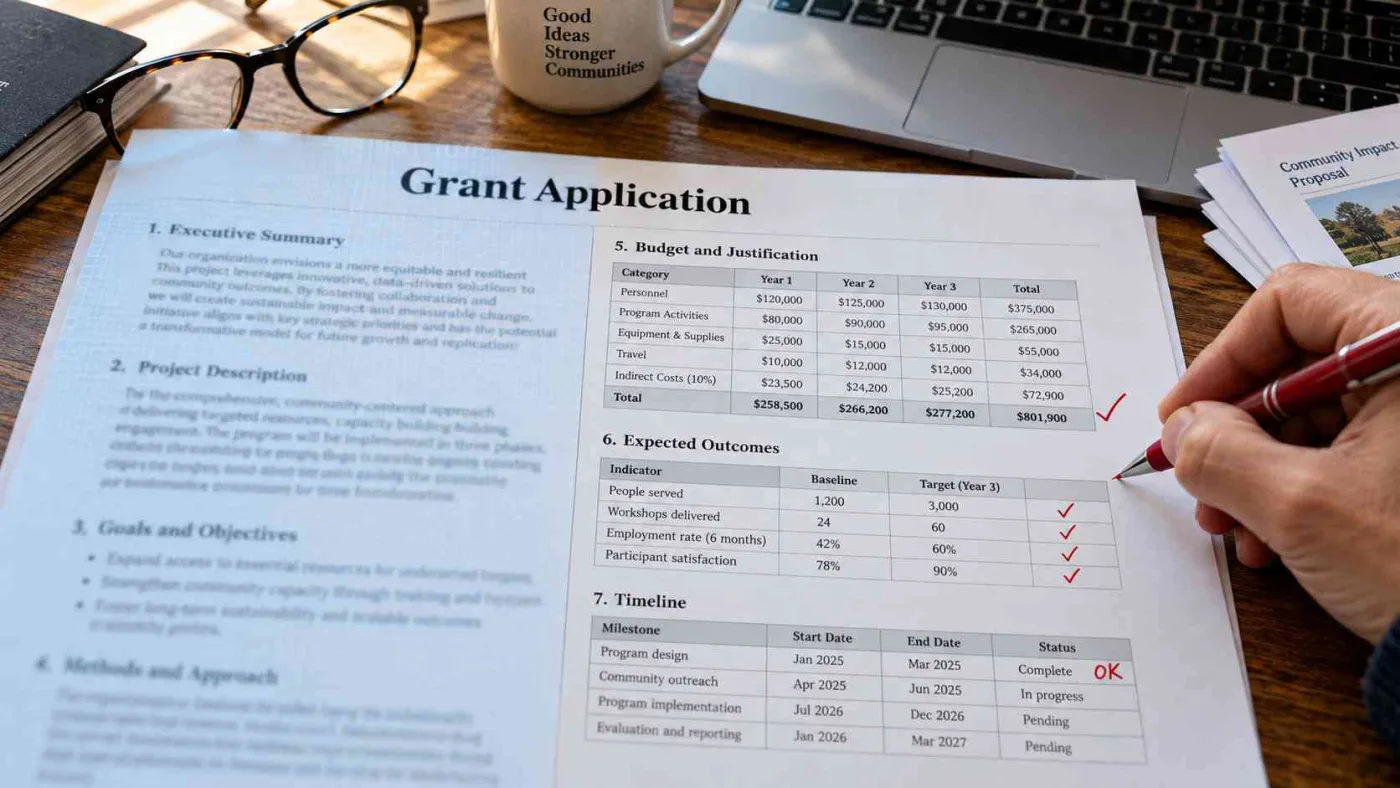
A grant application can become part of a signed agreement, so factual claims about your organisation's performance need verification. When it goes wrong, the consequences aren't a weak score, they're a funder relationship damaged by a number that didn't hold up, or worse, a compliance problem if the application becomes part of a signed agreement. A one- or two-person development team has no separate fact-checking function to catch an AI-generated overstatement before it's submitted, which means the check has to be built into how the tool is used, not assumed to happen automatically.
The nonprofit reality: a disclosed, hypothetical example
Imagine a small youth mentoring nonprofit using an AI tool to draft a renewal proposal, feeding it last year's programme report as context. The draft comes back fluent and well-organized, and it states that the programme "served 340 participants across six communities," a specific, confident-sounding number. The actual figure, buried two pages into the source report, is 230 participants who completed at least one session, plus 110 who attended a single orientation and never returned. The AI merged both figures into one number because the source document used "participants" loosely in two different places, and nothing in the drafting process flagged the discrepancy.
The programme director, reviewing the draft quickly before a deadline, nearly lets the number stand because it reads naturally and matches the general shape of what she remembers. She only catches it because she happens to cross-check against the funder's own definition of "participant" in their reporting guidelines, which requires a minimum of three sessions attended. Had the application gone out as drafted, the organisation would have reported a number it could not defend if the funder ever asked for the underlying data.
This is illustrative, not a documented incident, but it shows the mechanism: an AI tool doesn't invent numbers from nothing, it resolves ambiguity in source material confidently and silently, in whichever direction produces fluent prose, and a reviewer skimming for tone rather than checking each figure against its source is the point where the error survives into a submitted application.
NIST AI 600-1 describes confabulation as a generative AI risk. That supports checking confidently stated claims against their sources; it does not establish that every ambiguity will be resolved in the same way.
The Signature Test: a simple line between drafting and deciding
I use one question to sort every task in a grant application: would a named person be willing to sign their name next to this specific sentence, confirming they checked it against the source data themselves? If yes, AI can draft it and a human confirms it. If the honest answer is "I'd be signing off on something I didn't actually verify," that task doesn't belong to AI, no matter how well the draft reads.
This isn't about trusting or distrusting the tool in general. It's about which sentences carry institutional accountability if they turn out to be wrong, and a factual claim about your own organisation's results always does.
| Task | Can AI help? | Who must decide or verify |
|---|---|---|
| Drafting narrative language, transitions, tone | Yes, fully | Final read for voice, not for facts |
| Reformatting a budget into a funder's required template | Yes, fully | Spot-check totals match the source budget |
| Summarising a long programme report into a shorter brief | Yes, as a first pass | Someone who knows the source data checks every number and definition against the original |
| Stating participant counts, outcome rates, or other results | No, not alone | A named staff member checks each figure against the source dataset, using the funder's own definitions |
| Deciding whether a result is strong enough to lead with | No | Programme or leadership staff, based on judgement the AI has no basis to make |
| Confirming eligibility or compliance claims | No | Whoever is accountable for the grant agreement, not the drafter |
The pattern across the right-hand column is consistent: AI can shorten the distance to a first draft, but a named person has to be the one who can explain, if asked later, how a specific number was checked. That's the same accountability principle behind the AI Handover Test, applied one level down, to individual sentences inside a single document rather than to an entire tool rollout.
Choose the tool with these boundaries in mind using the Five Gates Test. If an error has already left the organisation, follow the incident response plan to contain it and correct the record.
My view
My rule is that fluency is not evidence. An AI draft that reads confidently and matches the general shape of what you remember is exactly the kind of error that survives a quick review, because it doesn't trigger suspicion the way an obviously wrong sentence would. I'd rather a team be slower and verify every number against its source than fast and trust a draft because it sounds right. The Signature Test is deliberately a low bar to clear for most of a grant application, drafting, formatting, structure, and a hard line for the handful of sentences that actually carry institutional risk.
What to do next
- Before your next AI-assisted application, list every sentence in the draft that states a number, a result, or an eligibility claim about your own organisation.
- For each one, confirm a named person checked it against the source data, using the funder's own definitions where they apply (as with "participant" above).
- Add one line to your internal process: AI drafts are reviewed for facts, not just tone, before anyone signs off.
- If your team doesn't yet have a source document for the numbers AI tools draw on (a clean programme report, a current outcomes tracker), build that first, since it's the thing an AI draft actually depends on for accuracy.
- Apply the same Signature Test to board reports and donor communications, not just grant applications, since the same risk shows up anywhere a draft states a result about your organisation.
Conclusion
Most guidance about AI and grant writing focuses on whether to use it at all. That's the wrong question for most small teams, who are already using it because it genuinely saves time on drafting and formatting. The question that actually protects an organisation is narrower: which specific sentences in this application state a fact about our own results, and has someone who knows the source data actually checked each one. An AI draft can resolve an ambiguous number confidently. The safeguard is to identify the sentences that need a named person's verification.
FAQ
Can AI write the entire first draft of a grant narrative?
Yes, for structure, tone, and transitions. It should not be trusted to independently state your organisation's participant counts, outcome rates, or eligibility status without a named person checking each of those specific claims against source data before submission.
What's the fastest way to check an AI-drafted number without re-reading the whole source report?
Search the source document for the specific term the AI used (like "participants") and check whether the funder's own reporting definition matches how the AI used it. Mismatched definitions, not outright invention, are the more common failure mode.
Does this apply differently to a one-person development team versus a larger team?
The principle is the same, but a one-person team has to be deliberate about building in the check themselves, since there's no second reviewer by default. Treating fact-verification as a separate step from tone-review, even when it's the same person doing both, helps catch what a single fast read would miss.
Should we tell funders we used AI to help draft the application?
Check the funder's current application guidance and agreement, and follow any disclosure requirements. If they are silent, explain AI's role when asked and keep a record of who checked the final facts. Human verification remains necessary whether or not disclosure is required.
Sources
About the author
Milan Bogojevic works on nonprofit grant intelligence, funding decisions and AI-assisted proposal processes for teams with limited capacity.
Last updated: 10 October 2026.